
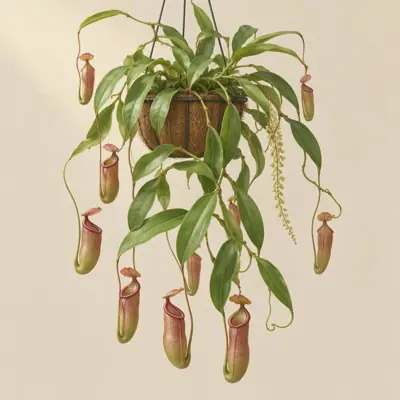
Pitcherplants (Nepenthes gaya)
Nepenthes is reported to consist mostly of creeping, climbing, or trailing vine-like carnivorous plants with pitchers. It is reported to be perennial and evergreen.
Overview
Nepenthes is reported to consist mostly of creeping, climbing, or trailing vine-like carnivorous plants with pitchers. It is reported to be perennial and evergreen.
Origin and habitat
Nepenthes is reported to occur mainly in the Old World tropics, including from southern China through Southeast Asia, the Malay Archipelago, and the Philippines, extending to India, Sri Lanka, Madagascar, the Seychelles, northern Australia, and some western Pacific islands; New Caledonia and the Solomon Islands are also listed. Its reported habitats span hot, humid lowlands, peat swamp forests, and tropical mountains with warm days and cooler nights; many species grow in rainforests as trailing or climbing plants. It is reported to occur in tropical to tropical montane climates, with lowland species favoring hot conditions and warm nights, while highland species favor warm days and distinctly cooler nights and generally require higher air humidity.
Characteristics
Sources differ, but mature height is reported at about 10–200 cm. Young or newly established plants are reported to grow more slowly, then begin producing vines rapidly once established; some mature species can make substantial annual extension. Leaves are reported to be alternate, usually sword-shaped to lanceolate and entire, with the midrib extending at the leaf tip into a tendril whose end develops into a pitcher. The plants are reported to have male and female flowers on separate individuals; flowers are usually arranged in racemes and less often in panicles, and are mainly pollinated by insects including flies, moths, wasps, and butterflies. They are reported to usually form four-angled capsules containing numerous seeds, with seeds generally having structures suited to wind dispersal.
Light
Nepenthes is reported to need bright light, but sources differ on light intensity: one recommends bright indirect light or partial sun while avoiding excessively strong direct light, whereas another recommends as much outdoor sun as possible from spring through autumn and ample sunlight through glass in winter.
Watering
During active growth, Nepenthes is generally kept evenly moist in a moist but well-drained medium that is not allowed to dry completely; in winter, watering may wait until the medium is somewhat drier. Pure water only (rain, RO or distilled) is reported to be appropriate, and watering is reported to use misting plus top watering.
Humidity and airflow
Nepenthes is generally reported to prefer high humidity, with the limited sources giving a range of about 50–80 %.
Temperature and dormancy
Nepenthes is generally reported to favor warm conditions, while being frost tender; keep above freezing. It is reported to have no dormancy.
Growing medium and mounting
Nepenthes is reported to grow in a moisture-retentive but well-drained medium, such as sphagnum moss alone or an acidic mixture containing materials such as humus, peat, perlite, or orchid medium; ordinary garden soil is not recommended for direct use.
Feeding
Fertilizing during active growth is reported as an option, with one source describing slow-release chemical fertilizer or fast-acting liquid fertilizer during summer and another suggesting organic fertilizer during the growing season when insects are unavailable. The plants are reported to feed on insects and other small prey, with organic fertilizer during the growing season suggested when insects are absent.
Propagation
Nepenthes is reported to be propagated by cuttings: vine sections with several nodes may have their lower leaves removed and upper leaves shortened before insertion into sphagnum moss, then be kept in bright shade with the moss moist until they root.
Common problems
Reported pests include aphids, scale insects, mealybugs, and thrips. Leaf spots and other fungal diseases are reported, with poor airflow associated with increased fungal problems. Pitchers may fail to form normally or may dry out when air humidity is too low; excessive light may scorch leaves, insufficient light may cause elongated and poorly colored leaves, and very high humidity combined with inadequate airflow may be associated with mold or fungal problems. Nepenthes is generally reported to have weak cold tolerance; lowland types are especially sensitive to low temperatures, while highland types require cooler nights, and temperature requirements differ substantially among species from different elevations.
Identification
Nepenthes is reported to form pitcher-shaped traps from tendrils at the leaf tips; the pitcher opening has a rim, while the interior contains trapping fluid, nutrient-absorbing glands, and smooth areas that impede prey escape. Many species are reported to produce differently shaped lower and upper pitchers on the same plant.