
Nepenthes × hookeriana (Nepenthes × hookeriana)
Nepenthes hookeriana is reported to be a perennial climbing carnivorous plant that can be grown terrestrially or in a hanging pot.
Overview
Nepenthes hookeriana is reported to be a perennial climbing carnivorous plant that can be grown terrestrially or in a hanging pot.
Origin and habitat
It is reported from tropical lowlands of Borneo, the Malay Peninsula, Singapore, Sumatra, and surrounding smaller islands, including the Natuna Islands. Reported habitats include recently disturbed forest clearings and moist rainforest; it may grow on the ground or as an epiphyte on fallen branches or tree trunks. Its reported climate is warm, humid, and tropical lowland.
Characteristics
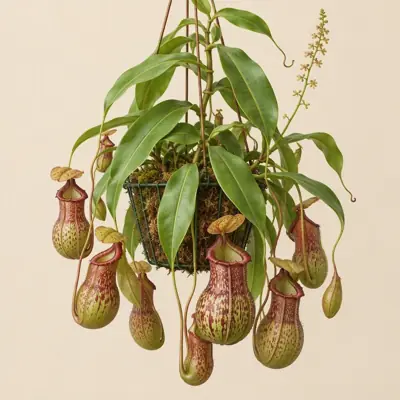
Growth is generally moderate to relatively fast, and a particular selected form is noted for vigorous growth. The leaves are green and narrow, with the midrib extending into a tendril that develops a pitcher at its tip. The flowers are reported to be yellowish brown and borne in clusters, with flowering reported throughout the year. A reported mature height is about 10–200 cm, based on few sources.
Light
Sources differ on light guidance, describing bright light to partial sun while advising against prolonged strong direct sunlight. A specialist source generally recommends bright light.
Watering
It is reported to do best with a moist but well-drained medium, using rainwater or distilled water and avoiding both complete drying and prolonged waterlogging. Reported guidance calls for pure water only (rain, RO or distilled), applied by misting plus top watering, and indicates that tray watering is not suitable. A specialist source generally recommends keeping the medium evenly moist.
Humidity and airflow
A specialist source reports humidity at about 50–80 %, with few sources available. It is reported to prefer high humidity.
Temperature and dormancy
Sources differ on the ideal temperature, reporting about 20–30 °C. It is reported to be sensitive to both temperatures that are too low and temperatures that are too high. It is reported to be frost tender and should be kept above freezing, with no dormancy.
Growing medium and mounting
A well-drained peat-based medium that is neutral to slightly acidic is reported to be suitable; general Nepenthes guidance also reports the use of sphagnum moss or orchid medium amended with peat and perlite. Sphagnum moss is also reported as a substrate.
Feeding
Sources differ on feeding guidance: Araflora advises no fertilizer for this hybrid, while other genus-level Nepenthes cultivation information provides fertilizing methods for the growing season. It is reported to require feeding.
Propagation
It is reported to be propagated by stem cuttings taken from vines with several nodes; lower leaves are removed, the upper leaf is trimmed substantially, and the cutting is placed in sphagnum moss under bright shade while the moss is kept moist until rooting.
Common problems
Reported pests include aphids, scale insects, mealybugs, and thrips. Leaf spot may occur, and poor ventilation is reported to potentially contribute to fungal disease. Insufficient light or low humidity may impair pitcher formation, while excessively strong direct sunlight may scorch the leaves. It is sensitive to low temperatures, and lowland Nepenthes are particularly intolerant of cold; guidance for this hybrid recommends avoiding excessively low temperatures.
Identification
Nepenthes hookeriana is a natural hybrid of Nepenthes ampullaria and Nepenthes rafflesiana, with relatively rounded pitchers, a smaller opening, and a broad peristome; the pitchers are often green with red blotches.
Sources
- Wikipedia (en): Nepenthes × hookeriana — CC BY-SA 4.0 · link
- Tom's Carnivores: Nepenthes (genus-level) — © Tom's Carnivores, facts only · link
- NHK みんなの趣味の園芸 植物図鑑: Nepenthes (genus-level) — © NHK出版, facts only · link
- NC State Plant Toolbox: Nepenthes (genus-level) — copyright (facts only) · link
- Tropical pitcher plant 'Nepenthes x hookeriana' (www.araflora.com) — facts only (§12) · link
- Nepenthes hookeriana - Carnivorous Pitcher Plant – Carnivero (carnivero.com) — facts only (§12) · link
- Complete care guide for Nepenthes hookeriana: light, watering, and environment (www.jardineriaon.com) — facts only (§12) · link
- Highland Nepenthes Growing Tips – California Carnivores (californiacarnivores.com) — facts only (§12) · link