
Nepenthes × mixta (Nepenthes × mixta)
Nepenthes mixta is reported to be an evergreen, climbing or creeping carnivorous vine. It is reported to be perennial.
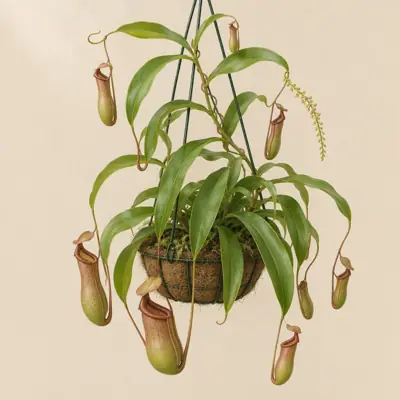
Overview
Nepenthes mixta is reported to be an evergreen, climbing or creeping carnivorous vine. It is reported to be perennial.
Origin and habitat
Sources differ on the distribution of the genus Nepenthes, describing it as occurring across the Old World tropics, including tropical Asia, Madagascar, the Seychelles, the Solomon Islands, New Caledonia, and northern Australia. Species in the genus are reported from warm, humid lowland environments and tropical mountains, with some lowland species occurring in peat-swamp forests. It is generally described as tropical; depending on parentage and group, plants may tend toward lowland, highland, or intermediate conditions and generally favor warmth and higher atmospheric humidity.
Characteristics
Few sources indicate a mature height of about 10–200 cm. The leaves are reported to be alternate, usually sword-shaped to lance-shaped with entire margins; the midrib extends beyond the leaf tip as a tendril that forms a pitcher at its end. Flowers are reported to be usually arranged in racemes and less often in panicles, with male and female flowers occurring on separate plants; the fruit generally forms a four-angled capsule containing winged, wind-dispersed seeds. Young plants are reported to grow slowly at first and require acclimation, while some mature Nepenthes can develop rapidly extending climbing stems.
Light
Sources differ, recommending bright indirect light or partial sun, or as much sun as possible from spring through autumn; strong direct sunlight may scorch the leaves. Nepenthes mixta is generally reported to need bright light.
Watering
It is reported to prefer a moist but well-drained growing medium that does not dry out from spring through autumn, while in winter the medium may be allowed to become drier before watering; NC State recommends rainwater or distilled water rather than tap water. It is reported to require pure water only (rain, RO or distilled), with misting plus top watering. It is generally recommended to keep evenly moist.
Humidity and airflow
Few specialist sources indicate humidity of about 50–90 %. It is generally reported to prefer high humidity.
Temperature and dormancy
It is reported to have limited cold tolerance. It is reported to have no dormancy.
Growing medium and mounting
It is reported to grow in sphagnum moss or a humus-rich, well-drained medium; sources also recommend sphagnum moss or orchid medium combined with peat and perlite, with the medium kept moist, well drained, and acidic rather than using ordinary garden soil. Sphagnum moss is reported as a suitable substrate.
Feeding
NHK is reported to recommend slow-release chemical fertilizer or fast-acting liquid fertilizer during summer growth, while NC State also mentions organic fertilizer during the growing period when insects are lacking. The pitchers are reported to obtain nutrients from insects and other small prey.
Propagation
It is reported to be propagated by vine cuttings placed in moist sphagnum moss in bright shade after lower leaves are removed and the upper leaves are cut in half; cultivated plants may also be propagated by tissue culture.
Common problems
It is reported to be susceptible to aphids, scale insects, mealybugs, and thrips. Leaf spots may occur, and poor airflow is reported to encourage fungal diseases. Specialist sources generally report that insufficient atmospheric humidity may prevent pitchers from forming normally or cause them to wither, while excessively strong direct sunlight may scorch leaves and insufficient light may result in weak, poorly colored leaves. Cold tolerance is reported to be low, with temperature requirements varying greatly among Nepenthes types; lowland types are particularly sensitive to cold, while highland types require a more pronounced nighttime temperature drop.
Identification
Nepenthes mixta is reported to have leaf-tip tendrils that form pitcher-shaped traps with a pitcher rim, lid, and internal digestive fluid that can capture insects and other small prey; mature plants usually form lower and upper pitchers that differ in form.
Sources
- GBIF Backbone: Nepenthes × mixta H.J.Veitch — CC BY 4.0 · link
- Wikipedia (en, genus): Nepenthes — CC BY-SA 4.0 · link
- Tom's Carnivores: Nepenthes (genus-level) — © Tom's Carnivores, facts only · link
- NHK みんなの趣味の園芸 植物図鑑: Nepenthes (genus-level) — © NHK出版, facts only · link
- NC State Plant Toolbox: Nepenthes (genus-level) — copyright (facts only) · link