
narrow swordfern (Nephrolepis cordifolia)
Nephrolepis cordifolia is an evergreen, rhizomatous perennial fern that can grow terrestrially or as an epiphyte and can spread by runners to form colonies; 'Duffii' is a cultivar with markedly shortened pinnae. It is reported to have a terrestrial growth habit.
Overview
Nephrolepis cordifolia is an evergreen, rhizomatous perennial fern that can grow terrestrially or as an epiphyte and can spread by runners to form colonies; 'Duffii' is a cultivar with markedly shortened pinnae. It is reported to have a terrestrial growth habit.
Origin and habitat
The species is widely distributed through tropical and subtropical regions, including Asia, Australia, and Pacific islands, and is native to Taiwan; sources differ on whether Africa is also part of its native range. Sources differ on the uncertain reported origin of 'Duffii', which may be New Zealand or islands of the South Pacific. Sources differ in habitat descriptions: it may grow on the ground or as an epiphyte in sunny coastal sites, dry slopes, rock surfaces, and trees, while other records place it in swamps, ditches, and other moist environments.
Characteristics
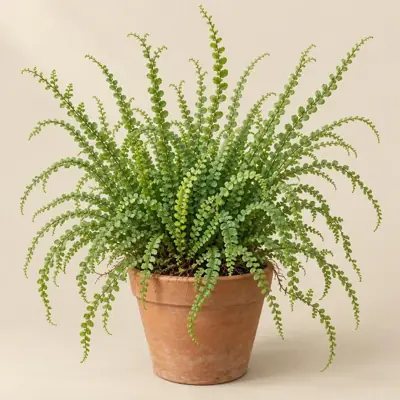
Sources differ on mature height, reported at about 50–100 cm. Based on limited sourcing, mature spread is reported at about 50–100 cm. Sources differ in descriptions of the foliage: 'Duffii' has very short, small, irregular pinnae ranging from flattened-rounded to semicircular, with blunt tips and occasional forking of the petiole and rachis, while the species has narrow, elongated, once-pinnate leaves. It is reported to have an erect rhizome.
Light
Bright indirect light or partial shade is suitable, and Nephrolepis cordifolia tolerates shade; sources differ on stronger light, with the species reported to tolerate full sun while Japanese horticultural information recommends avoiding strong direct sunlight.
Watering
Keep the growing medium evenly moist and well drained during active growth; from spring through autumn, do not allow the potting medium to dry out completely, while in winter allow it to begin drying before watering and reduce watering.
Humidity and airflow
Nephrolepis cordifolia prefers high humidity and is reported to need moderate airflow.
Temperature and dormancy
Nephrolepis cordifolia is generally classed as tender. It is reported under the RHS H1B classification.
Growing medium and mounting
Use a humus-rich, well-drained growing medium; loamy or sandy media can be used, with acidic to neutral conditions being suitable.
Feeding
During active growth, sources describe alternatives including slow-release fertilizer, fast-acting liquid fertilizer, or a diluted balanced liquid fertilizer applied at differing intervals.
Propagation
Nephrolepis cordifolia can be propagated by division, by plantlets produced on runners, or by spores, although offspring of cultivars raised from spores may not retain cultivar characteristics. 'Duffii' is reported to form sori only rarely. One source reports division involving removal of some potting medium and thinning of some fronds.
Common problems
Scale insects and slugs are recorded pests, and the Florida fern caterpillar is also recorded by another source. Anthracnose is reported to occur during part of the year. Excessively wet foliage may rot, and in some introduced regions the plant can escape cultivation and become invasive. This tropical to subtropical fern is described in Japanese horticultural information as having weak cold tolerance; within Nephrolepis the species is relatively more cold-tolerant, but freezing should be avoided.
Identification
'Duffii' is distinguished by its strongly shortened, small, flattened-rounded to semicircular pinnae, occasional forking of the rachis and petiole, and rare formation of sori. The species also has runners and spherical tubers.
Photos


Sources
- GBIF Backbone: Nephrolepis cordifolia (L.) C.Presl — CC BY 4.0 · link
- Wikipedia (en): Nephrolepis cordifolia — CC BY-SA 4.0 · link
- Wikipedia (ja): タマシダ — CC BY-SA 4.0 · link
- Wikipedia (de): Nephrolepis cordifolia — CC BY-SA 4.0 · link
- Wikipedia (es): Nephrolepis cordifolia — CC BY-SA 4.0 · link
- NC State Plant Toolbox: Nephrolepis cordifolia — copyright (facts only) · link
- Wikipedia (nl): Nephrolepis cordifolia — CC BY-SA 4.0 · link
- TaiCOL 臺灣物種名錄: Nephrolepis cordifolia — CC BY 4.0 · link
- RHS Plants: Nephrolepis cordifolia — © RHS, facts only · link
- USDA PLANTS Database: Nephrolepis cordifolia — Public domain (US Government work) · link
- 臺北典藏植物園 植物資料庫: Nephrolepis cordifolia — © 臺北典藏植物園, facts only · link
- NHK みんなの趣味の園芸 植物図鑑: Nephrolepis cordifolia — © NHK出版, facts only · link