
jasmine tobacco (Nicotiana alata)
Nicotiana alata is an upright herbaceous plant. Sources differ in describing it as a short-lived perennial that is often grown as an annual where hardiness is insufficient.
Track your jasmine tobacco in the PLNTverse app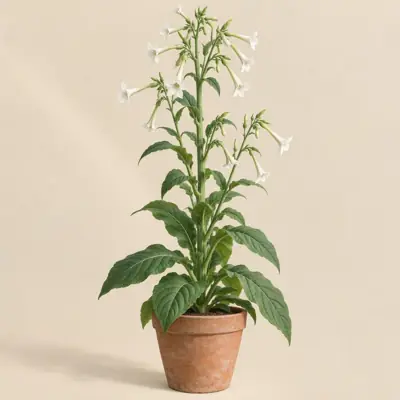
Overview
Nicotiana alata is an upright herbaceous plant. Sources differ in describing it as a short-lived perennial that is often grown as an annual where hardiness is insufficient.
Origin and habitat
Nicotiana alata is native to South America, specifically including southern Brazil, northern or northeastern Argentina, Paraguay, and Uruguay.
Characteristics
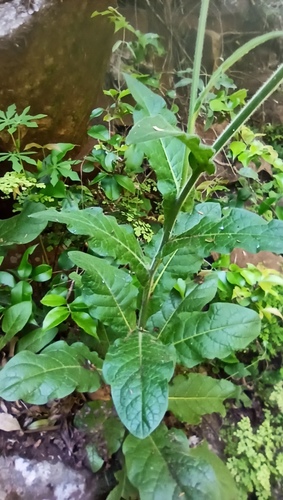
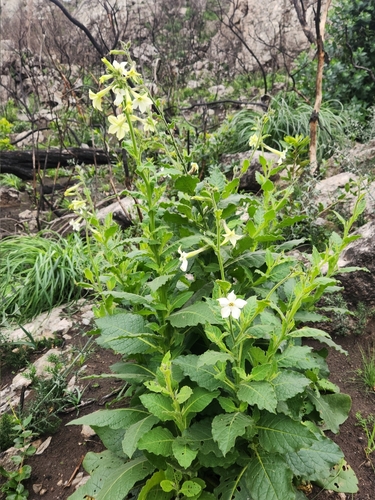
The leaves are reported to be alternate, with larger lower leaves ranging from elliptic to spoon-shaped and smaller upper leaves; they may clasp the stem and form wing-like extensions. Sources differ in describing the flowers: the corolla is long-tubed to funnel-shaped and opens into a star-shaped, lobed tip; wild forms are mainly white or greenish-yellow-white, while cultivated forms may be white, yellow, pink, red, dark red, purple, or yellow-green, with a pronounced fragrance that is particularly strong from evening into the night. Flowering is reported to occur mainly from summer into autumn, with some accounts describing peak flowering in late summer.
Growing medium and mounting
Sources differ in describing its soil preferences: it favors deep, fertile, organic-rich soil that is moist but well drained, can adapt to loamy, sandy, and chalky soils, and can grow from acidic to alkaline conditions.
Propagation
Nicotiana alata is reported to be propagated mainly by seed, either sown directly or started indoors; the small seeds require light for germination. It is also reported to produce young plants from the roots that can be propagated by division.
Common problems
Aphids and moth larvae are reported as possible pests; aphids readily gather on new growth, while the larvae may feed on flower buds. Nicotiana alata is reported to have poor drought tolerance, and covering its small, light-requiring seeds during propagation may reduce germination performance. Plants sold as flowering tobacco are also reported to be commonly shorter hybrids rather than true Nicotiana alata.
Identification
Nicotiana alata is reported to have ridged, winged stems and may bear sticky glandular hairs; its flowers are long-tubed, open at night or become especially fragrant at night, and can attract nocturnal moths.
Photos


Sources
- 維基百科:翼柄烟草 — CC BY-SA 4.0 · link
- Wikipedia (ja): シュッコンタバコ — CC BY-SA 4.0 · link
- Wikipedia (fr): Nicotiana alata — CC BY-SA 4.0 · link
- GBIF descriptions: Manual of the Alien Plants of Belgium; Inventory of the urban flora of Budapest (Hungary) highlighti — per dataset · link
- Useful Tropical/Temperate Plants: Nicotiana alata — CC BY-NC-SA 3.0 (facts only) · link
- USDA PLANTS Database: Nicotiana alata — Public domain (US Government work) · link