
sweet basil (Ocimum basilicum)
Ocimum basilicum is an upright, highly branched, aromatic herb. It is commonly grown as an annual, while in warm tropical conditions it may be a short-lived perennial or perennial; sources differ, with some also describing it as biennial.
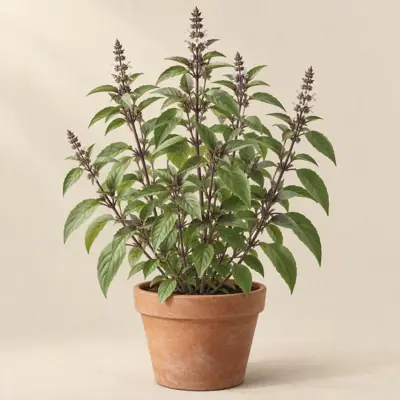
Overview
Ocimum basilicum is an upright, highly branched, aromatic herb. It is commonly grown as an annual, while in warm tropical conditions it may be a short-lived perennial or perennial; sources differ, with some also describing it as biennial.
Origin and habitat
Its main native range is described as tropical to subtropical Asia, with some sources extending it to New Guinea and northern Australia; sources differ on whether Africa is part of its native range. It has a long history of cultivation, so its original natural habitat is unclear; it is also recorded in woodland, savanna, shrubland, grassland, and human-made environments. It is suited to tropical, subtropical, and warm environments and can be grown as an annual in warm temperate conditions; it prefers warmth and is not tolerant of frost or cold.
Characteristics
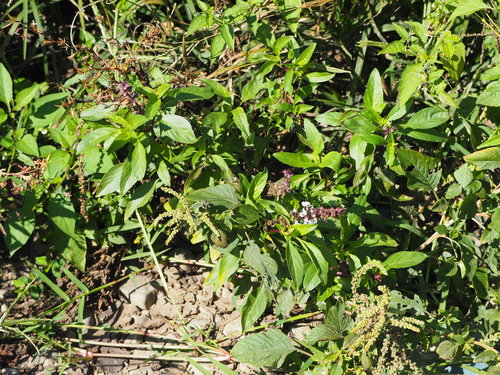
Sources differ and are few, placing mature height at about 30–150 cm; a limited source reports a mature spread of about 10–50 cm. The opposite leaves are usually green and ovate to ovate-lanceolate, with margins that may be smooth, slightly toothed, or bluntly toothed; some descriptions note a glossy surface, and cultivars vary markedly in leaf size, shape, and color. The small, lipped flowers are usually white, though pale pink or purple is also recorded, and they are arranged in terminal spikes. Flowering is mainly from summer into early autumn; after pollination, the corolla falls and small nut-like fruits form within the calyx, with one source describing the mature fruits as black.
Light
Ocimum basilicum prefers full sun and a position with plentiful sunlight.
Watering
Maintain moderate moisture while avoiding poor drainage; sources commonly recommend moist but well-drained soil, while some information indicates that the plant can also adapt to a drier, well-drained medium.
Temperature and dormancy
Based on limited source information, a reported minimum is about 7 °C, an ideal range is about 18–27 °C, and a reported maximum is about 36 °C. It is generally assigned the RHS H1C hardiness rating.
Growing medium and mounting
It grows in fertile, well-drained soil, including loam or sandy soil; sources also describe a preference for nutrient-rich, lighter-textured soil and a particular pH preference with tolerance of a broader pH range.
Propagation
Ocimum basilicum can be propagated from seed; seed may be sown after conditions become warm, and seedlings can also be transplanted.
Common problems
Potential pests include aphids, Japanese beetles, slugs, snails, and sage leafhoppers. Basil downy mildew is reported by one source as a common disease. Cold or frost and pests such as aphids, beetles, slugs, and snails may cause cultivation problems. The plant is sensitive to cold and does not tolerate frost; it is better suited to warm conditions and a sunny, relatively sheltered position.
Identification
Key identifying features are square stems, opposite aromatic leaves, and terminal flower spikes. Sources describe Thai basil as a cultivated type of Ocimum basilicum with a stronger flavor, while Chinese-language sources also record red-stemmed and green-stemmed types; accounts differ.
Photos


Sources
- Wikipedia (en): Basil — CC BY-SA 4.0 · link
- 維基百科:羅勒 — CC BY-SA 4.0 · link
- Wikipedia (ja): バジル — CC BY-SA 4.0 · link
- Wikipedia (de): Basilikum — CC BY-SA 4.0 · link
- Wikipedia (es): Ocimum basilicum — CC BY-SA 4.0 · link
- GBIF descriptions: Manual of the Alien Plants of Belgium; Checklist of introduced taxa in Cyprus; Checklist of introduc — per dataset · link
- NC State Plant Toolbox: Ocimum basilicum — copyright (facts only) · link
- Useful Tropical/Temperate Plants: Ocimum basilicum — CC BY-NC-SA 3.0 (facts only) · link
- RHS Plants: Ocimum basilicum — © RHS, facts only · link
- USDA PLANTS Database: Ocimum basilicum — Public domain (US Government work) · link