
holy basil (Ocimum tenuiflorum)
Ocimum tenuiflorum is an upright, highly branched aromatic herb to subshrub. Sources differ in describing its life cycle: it is perennial or short-lived perennial and is grown as an annual in some cultivation settings.
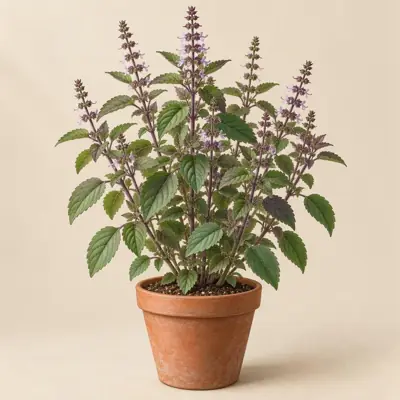
Overview
Ocimum tenuiflorum is an upright, highly branched aromatic herb to subshrub. Sources differ in describing its life cycle: it is perennial or short-lived perennial and is grown as an annual in some cultivation settings.
Origin and habitat
Sources differ on the details of its native range, but describe it as mainly native to tropical and subtropical Asia, extending to northern Australia, with some accounts additionally including the Indian subcontinent, Southeast Asia, China, New Guinea, and the western Pacific; it is now naturalized in many tropical regions, including the Americas. It occurs in moist to wet lowland tropical environments and may also naturalize in wasteland, around settlements, and in scrub. It is associated with tropical to subtropical climates and prefers warm, sunny, well-drained conditions.
Characteristics
Sources differ on mature height, placing it at about 30–100 cm, while the few available sources report a mature spread of about 10–50 cm and generally describe growth as fast. The strongly aromatic, simple, stalked leaves are opposite, green to purple, roughly ovate to oblong, and have slightly serrated or toothed margins. Small white, pink, reddish-purple, or purple flowers are arranged in terminal elongated spike-like or raceme-like inflorescences and whorls, and one source reports flowering in summer. The fruit is reported to consist of brown, slightly ovoid, somewhat bumpy nutlet-like segments.
Light
Full sun is preferred, although some sources indicate that partial sun is acceptable.
Watering
Water regularly, keeping the soil moist but well drained; prolonged waterlogging is not tolerated.
Temperature and dormancy
With few sources available, the reported minimum is about -1 °C, the ideal range about 20–28 °C, and the maximum about 35 °C. Sources differ on its USDA hardiness-zone classification. It is generally frost tender; keep above freezing.
Growing medium and mounting
It prefers moist but well-drained soil and can grow in loamy or sandy soil; sources differ in their descriptions, with some also favoring fertile, light, well-drained soil and indicating adaptability across a broad pH range.
Propagation
It can be propagated by seed; seed may be sown in warm conditions indoors or in a glasshouse in spring, and plants also readily self-seed.
Common problems
Japanese beetles, aphids, and leafhoppers may cause damage, and Japanese beetles can leave only the leaf veins and cause defoliation. Powdery mildew may occur, while cool, wet, cloudy conditions can lead to problems with gray mold. Plants grow poorly in waterlogged conditions and, outside the native range, may self-seed and spread into an aggressive weed. It is sensitive to frost and freezing, while cool, wet, cloudy conditions may also increase the risk of gray mold.
Identification
Ocimum tenuiflorum is aromatic, with hairy, highly branched stems and opposite leaves; compared with similar Ocimum plants, the absence of a tooth at the base of the rear stamens is an important distinguishing feature, and the associated parts have feathery to tufted-hairy structures.
Photos


Sources
- Wikipedia (en): Ocimum tenuiflorum — CC BY-SA 4.0 · link
- 維基百科:圣罗勒 — CC BY-SA 4.0 · link
- Wikipedia (ja): カミメボウキ — CC BY-SA 4.0 · link
- Wikipedia (de): Indisches Basilikum — CC BY-SA 4.0 · link
- Wikipedia (fr): Ocimum tenuiflorum — CC BY-SA 4.0 · link
- Wikipedia (es): Ocimum tenuiflorum — CC BY-SA 4.0 · link
- GBIF descriptions: Especies presentes en el catálogo virtual del Tropicario del Jardín Botánico de Bogotá; Listado de e — per dataset · link
- NC State Plant Toolbox: Ocimum tenuiflorum — copyright (facts only) · link
- Wikipedia (it): Ocimum tenuiflorum — CC BY-SA 4.0 · link
- TaiCOL 臺灣物種名錄: Ocimum tenuiflorum — CC BY 4.0 · link
- Useful Tropical/Temperate Plants: Ocimum tenuiflorum — CC BY-NC-SA 3.0 (facts only) · link
- RHS Plants: Ocimum tenuiflorum — © RHS, facts only · link
- USDA PLANTS Database: Ocimum tenuiflorum — Public domain (US Government work) · link
- Top Tropicals catalog: Ocimum tenuiflorum — © Top Tropicals LLC (facts only) · link