
Lemon basil (Ocimum × africanum)
Ocimum africanum is reported to be an herbaceous plant. Sources differ in describing its life cycle; it is described as annual.
Overview
Ocimum africanum is reported to be an herbaceous plant. Sources differ in describing its life cycle; it is described as annual.
Origin and habitat
Ocimum africanum is reported from temperate to tropical parts of Africa and Asia, including Ethiopia, Kenya, Tanzania, Uganda, Cameroon, the Democratic Republic of the Congo, Angola, Malawi, Madagascar, India, southern and central-eastern China, Laos, Thailand, Cambodia, Vietnam, Taiwan, Malaysia, and the Middle East. It is reported to be a plant of tropical and warm Asian regions, with major cultivation areas in northeastern Africa and South Asia.
Characteristics
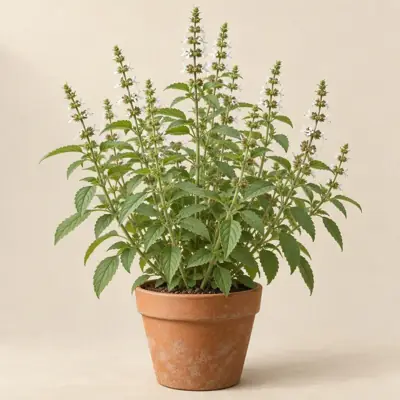
Sources differ on mature height, placing it at about 20–40 cm. The leaves are reported to resemble basil leaves but are generally narrower with slightly serrated margins; another description reports smaller, oblong leaves with sparsely hairy petioles. The flowers are reported to be white, bisexual, bilaterally symmetrical, and to have a double perianth with parts arranged in a consistent floral pattern. Flowering is reported from late summer to early autumn, after which seeds form and can be left to dry on the plant.
Light
It is reported to do well in a position receiving substantial direct sunlight each day.
Watering
Watering is reported to be appropriate when the surface soil has dried; the plant may wilt when short of water and can recover after watering.
Feeding
Organic or chemical fertilizer is reported to be usable; without fertilizer the plant may continue growing, but its flavor may be affected.
Propagation
Ocimum africanum is reported to be propagated by seed or stem cuttings. Seedlings are reported to reach a transplant-related stage after several weeks, while stem cuttings placed in water begin rooting and later develop roots suitable for transplanting.
Common problems
If allowed to flower during harvest, the plant is reported to lose aroma, while its leaves become smaller, dry, and leathery; a complete lack of fertilizer may also affect flavor. It is reported to be intolerant of winter frost, and cold frosts can kill the plant.
Identification
Ocimum africanum is reported to have a distinct lemon aroma and, compared with common basil, more branched and ascending stems, smaller oblong leaves, more sparse hairs on the petioles and flower whorls, and more elongated racemes.
Photos

