
olive tree (Olea europaea)
Olea europaea is a perennial evergreen tree or shrub.
Overview
Olea europaea is a perennial evergreen tree or shrub.
Origin and habitat
Sources differ on its native range, but place its core in the Mediterranean region, with some accounts extending it to the eastern Mediterranean coast, western Asia, and northern Iran. It occurs in woodland and scrub in dry, rocky areas and is broadly adapted to Mediterranean-type environments. It prefers a Mediterranean-type climate with hot, dry summers and mild, wetter winters, and tolerates drought and high temperatures.
Characteristics
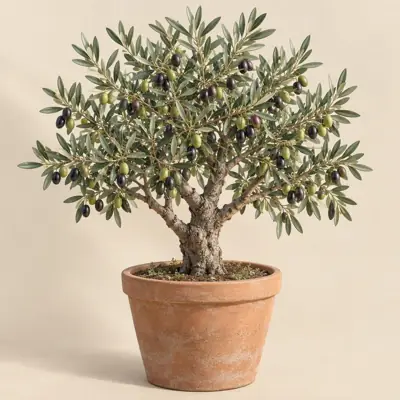
Sources differ, with few sources indicating a mature height of about 800–1500 cm and a mature spread of about 457–762 cm. Growth is slow, and the opposite, leathery leaves range from elliptic to lance-shaped or narrowly obovate, with gray-green to dark green upper surfaces and silvery-gray undersides. The small white to whitish flowers are borne in axillary inflorescences, and some sources describe them as fragrant; flowering occurs in summer in the Northern Hemisphere. Sources differ in descriptions of the drupe, which is initially green and may become purple-black when mature.
Light
Olea europaea prefers full sun.
Watering
It prefers well-drained soil with moderate moisture, while established plants tolerate drought and can grow in dry soil.
Temperature and dormancy
A single source reports tolerance down to about -10 °C, so sources are few for this temperature limit. A single source generally reports Olea europaea within a USDA hardiness-zone range.
Growing medium and mounting
Deep, fertile, well-drained soil is preferred; it can grow in loam and adapt to chalk, clay, and sand, with broad tolerance of soil pH.
Propagation
It can be propagated from seed or semi-ripe cuttings, with sowing in spring and semi-ripe cuttings taken in summer.
Common problems
Scale insects are reported as a pest. Once established, the plant tolerates drought and hot, dry conditions, while a sheltered growing position is recommended.
Identification
Olea europaea is evergreen with dense branches and foliage and silvery leaf undersides; older trunks can become rough, twisted, and knotted, and mature plants form drupes.
Photos


Sources
- 維基百科:油橄欖 — CC BY-SA 4.0 · link
- Wikipedia (ja): オリーブ — CC BY-SA 4.0 · link
- Wikipedia (de): Olivenbaum — CC BY-SA 4.0 · link
- Wikipedia (fr): Olea europaea — CC BY-SA 4.0 · link
- Wikipedia (es): Olea europaea — CC BY-SA 4.0 · link
- NC State Plant Toolbox: Olea europaea — copyright (facts only) · link
- Useful Tropical/Temperate Plants: Olea europaea — CC BY-NC-SA 3.0 (facts only) · link
- RHS Plants: Olea europaea — © RHS, facts only · link
- USDA PLANTS Database: Olea europaea — Public domain (US Government work) · link