
Operculicarya decaryi (Operculicarya decaryi)
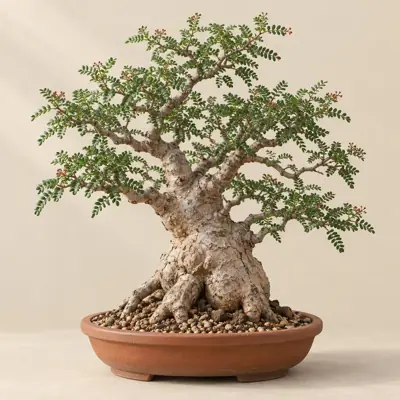
Operculicarya decaryi is a perennial, deciduous caudiciform or pachycaul succulent shrub to tree that can develop enlarged water-storing roots and a stout trunk and is often grown as bonsai. Sources differ on its deciduous behavior: it is usually deciduous but may remain evergreen in very tropical conditions.
Overview
Operculicarya decaryi is a perennial, deciduous caudiciform or pachycaul succulent shrub to tree that can develop enlarged water-storing roots and a stout trunk and is often grown as bonsai. Sources differ on its deciduous behavior: it is usually deciduous but may remain evergreen in very tropical conditions.
Origin and habitat
It is native to southern and southwestern Madagascar, including the Toliara and Fianarantsoa regions. It is reported to grow in xeric scrub and forest. It is adapted to arid environments and warm to hot climates, tolerates drought but not freezing, prefers warmth during growth, and requires a dry, cooler season to promote flowering.
Characteristics
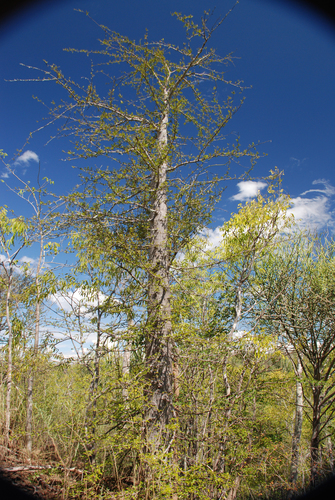
Sources differ on mature height, placing it at about 500–900 cm, and it grows very slowly; it usually remains relatively low, though some sources report taller plants. The evenly pinnate leaves bear several pairs of small, nearly round to ovate leaflets that are glossy dark green above and paler beneath; sources differ on the leaf details, and the leaves are usually shed in winter. The very small, inconspicuous flowers are dark red to purplish red, unisexual, and borne on separate male and female plants in small inflorescences at the ends of short shoots; flowering occurs from winter to late winter. The fruit is reported to be a stalked, spherical to teardrop-shaped drupe containing a mostly single-chambered woody stone with a small lid-like structure, and the plant has a thickened trunk (pachycaul).
Light
Grow it in full sun to bright partial sun; indoors it needs bright light.
Watering
Sources differ on watering details: during active leafy growth it can be watered regularly, but the medium must drain well, and while in leaf, water when the mix has dried. Water sparingly while leafless; indoors, keep it relatively dry and avoid waterlogging that can cause root rot.
Temperature and dormancy
Operculicarya decaryi is frost tender; keep above freezing, and it drops its leaves and goes dormant. A specialist source reports temperature limits of about 10 °C and 45 °C, but sources are few. One source reports a cold minimum of about -3 °C, but sources are few. It is generally reported to have high heat tolerance, while sources differ on its hardiness-zone designation.
Growing medium and mounting
Use a loose, porous, very well-drained granular or sandy medium; succulent mixes or light potting media are also suggested. It needs a fast-draining mix.
Feeding
Feed regularly during the growing period; bonsai sources recommend a balanced NPK fertilizer and reduced feeding in winter.
Propagation
It can be propagated from seed, stem cuttings, or pieces of tuberous root; sources differ on propagation details. Seed propagation is slow and may involve soaking seed in warm water before sowing in moist sand, while woody or stem cuttings require an evenly moist medium. Cuttings are a supported propagation method.
Common problems
Aphids are reported as a pest to watch for. Waterlogged medium or excessively wet indoor conditions can cause root rot; insufficient water may be accompanied by leaf drop, although natural winter dormancy also causes leaf drop. Sources differ on weather-sensitivity details, but it is sensitive to frost and freezing conditions, and in cold regions it should be moved to a warmer, bright location in winter.
Identification
Operculicarya decaryi has thick, swollen, water-storing fleshy roots and a stout stem; its trunk may be bottle-shaped, barrel-shaped, spherical, or conical, with dark gray bark marked by wart-like irregularities and fissures. Its branches are slender, spreading, and zigzagging, with small leaflets.
Photos


Sources
- Wikipedia (en): Operculicarya decaryi — CC BY-SA 4.0 · link
- Wikipedia (fr): Faux-poivrier du Japon — CC BY-SA 4.0 · link
- LLIFLE Encyclopedia of living forms: Operculicarya decaryi — CC BY-SA · link
- Desert-Tropicals: Operculicarya decaryi — © Philippe Faucon (desert-tropicals.com), facts only · link
- Top Tropicals catalog: Operculicarya decaryi — © Top Tropicals LLC (facts only) · link
- Operculicarya decaryi | Giromagi Cactus and Succulents for sale | Buy plants onl (www.giromagi.com) — facts only (§12) · link
- PUKUBOOK: Operculicarya decaryi — CC BY-NC (facts only) · link