
Operculicarya pachypus (Operculicarya pachypus)
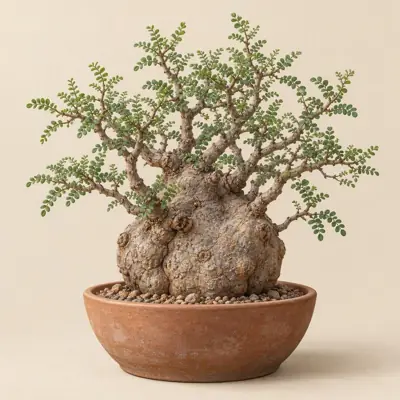
Operculicarya pachypus is a deciduous shrub to small tree with a thickened trunk and enlarged roots.
Overview
Operculicarya pachypus is a deciduous shrub to small tree with a thickened trunk and enlarged roots.
Origin and habitat
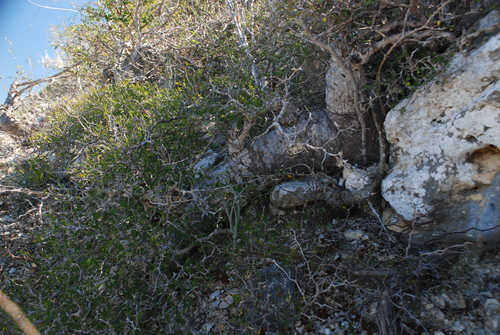
Operculicarya pachypus is native to Madagascar, with more detailed sources placing it in a restricted area of southwestern Madagascar near Toliara. It is reported to grow in lowland dry forest on sandy, calcareous soil. It is reported to come from a dry lowland environment and, in cultivation, to prefer warm conditions from spring through autumn and a dry, cooler season to encourage flowering.
Characteristics
Sources differ on mature height, placing it at about 0–120 cm; growth is quite slow, and it develops a thickened trunk (pachycaul). The leaves are reported to be very small, hairless and slightly leathery, with several pairs of nearly round to slender teardrop-shaped leaflets that have rounded or slightly notched tips, glossy upper surfaces ranging from green to dark green with bronze-brown tones, and paler undersides. The flowers are extremely small and yellow-green, with male and female flowers borne on separate plants, and flowering occurs in late winter; the fruit is reported to be stalked, nearly spherical and slightly flattened from the sides. The plant can reach a small-tree stature.
Light
Provide full sun to bright partial sun; indoors, bright light is preferred.
Watering
During warm growth while in leaf, water regularly, with more generous watering possible in a well-drained mix, while indoor plants are best kept on the dry side; during possible winter dormancy, reduce watering to lower the risk of rot. It is generally reported that while in leaf, water when the mix has dried, and water sparingly while leafless.
Temperature and dormancy
A minimum temperature of 10 °C is given, while a maximum of about 45 °C is reported by few sources. Sources differ on its hardiness-zone classification; it is frost tender and should be kept above freezing. It drops its leaves and goes dormant. Few sources report an active-temperature range of about 15–45 and a cold minimum of about -5 °C.
Growing medium and mounting
It is generally reported to prefer a porous, gravelly or sandy medium with a substantial inorganic component and near-neutral pH, and it needs a very fast-draining mix.
Feeding
Regular feeding is reported to help maintain growth and plant health.
Propagation
Sources differ on propagation: root cuttings are described, while other accounts list cuttings and seed, with inconsistent descriptions of seed reliability. One source reports propagation by cuttings, seed, and tuberous root pieces.
Common problems
Indoors, excessive moisture is reported to make the plant prone to rot. Sources differ in their descriptions of weather sensitivity, but report sensitivity to frost and advise avoiding frost or freezing.
Identification
The stout trunk is conical to irregularly pyramidal and silver-gray, with bark ranging from relatively smooth to very knobby; the hairless branches are often strongly zigzagging and may end in spine-like tips, while the roots are often enlarged and twisted. Hairless branches and yellow-green flowers are important features distinguishing it from Operculicarya decaryi.
Photos

Sources
- GBIF Backbone: Operculicarya pachypus Eggli — CC BY 4.0 · link
- Wikipedia (en): Operculicarya pachypus — CC BY-SA 4.0 · link
- LLIFLE Encyclopedia of living forms: Operculicarya pachypus — CC BY-SA · link
- Desert-Tropicals: Operculicarya pachypus — © Philippe Faucon (desert-tropicals.com), facts only · link
- Top Tropicals catalog: Operculicarya pachypus — © Top Tropicals LLC (facts only) · link
- PUKUBOOK: Operculicarya pachypus — CC BY-NC (facts only) · link