
Barbary fig (Opuntia ficus-indica)
Opuntia ficus-indica is a large perennial succulent shrub that can also become tree-like, with older plants developing a distinct woody main trunk. It has an opuntioid (pad-forming) growth form.
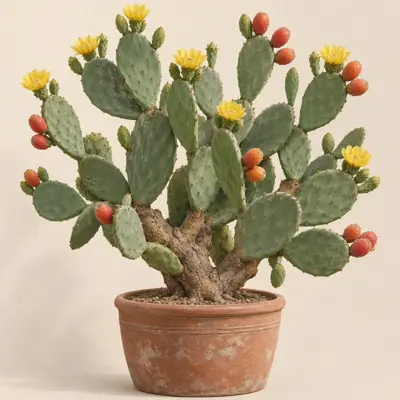
Overview
Opuntia ficus-indica is a large perennial succulent shrub that can also become tree-like, with older plants developing a distinct woody main trunk. It has an opuntioid (pad-forming) growth form.
Origin and habitat
Its native range is difficult to determine precisely because of long domestication; most sources point to Mexico, especially central Mexico, while some listings refer more broadly to Central America, so sources differ. It is adapted to dry, semi-arid, and rocky environments and can grow where rainfall is irregular and soils are poor and prone to erosion; it has become naturalized in warm regions such as the Mediterranean. It favors warm, dry to semi-arid climates, tolerates drought and high temperatures, is more sensitive to freezing conditions, and is widely cultivated or occurs outside cultivation in warm regions worldwide.
Characteristics
Sources differ on mature size, placing height at about 100–600 cm and spread at about 400–800 cm. Growth is reported to be slow, and the true leaves are conical and very small, appearing only on young stem segments and soon falling away; photosynthesis is carried out mainly by the flattened green succulent stem segments. Flowers are borne along the edges or at the tips of stem segments and may be yellow, orange, or red, with some sources also recording white; flowering occurs from spring through summer. The fleshy berries are ovoid to elliptical and may mature to yellow-green, orange, red, or purplish red; their surface bears glochids and sometimes spines, while the flesh is juicy and contains many seeds.
Light
It takes full sun, and ample sunlight supports flowering.
Watering
It is drought tolerant and needs well-drained growing medium; during the growing season, allow the medium to dry before watering, while watering can stop during winter dormancy. Once established, it needs very little water, and standing water should be avoided.
Humidity and airflow
It is reported to need good airflow.
Temperature and dormancy
It is reported to be frost hardy, although sources differ in their descriptions of its cold tolerance. Limited sources place its cold minimum at about -10 °C, while sources differ on the minimum-temperature information.
Growing medium and mounting
It does well in well-drained loam or sandy soil and can adapt to poor soils, but does not tolerate prolonged waterlogging. For container growing, a fast-draining cactus medium can be used; it needs a fast-draining mix.
Feeding
A single source reports that balanced liquid fertilizer may be applied during active growth in spring, summer, and early autumn, with feeding stopped in winter.
Propagation
It can be propagated from stem-segment cuttings or by seed.
Common problems
Dactylopius coccus can infest the plant, while genus-level information for Opuntia also lists scale insects and mealybugs as possible pests. Poor drainage can lead to root rot, and a single source also reports root-rot risk under poorly drained conditions. Glochids detach easily and can penetrate the skin, causing irritation and discomfort. It tolerates drought and high temperatures but is more sensitive to freezing cold; large plants may topple in strong winds or typhoon conditions, and supports can be added for outdoor cultivation.
Identification
It has thick, flattened succulent stem segments, or cladodes, with a waxy surface; the areoles bear small, barbed glochids that detach easily, while ordinary long spines may be inconspicuous or absent. Older plants can develop a distinct woody main trunk.
Photos


Sources
- GBIF Backbone: Opuntia ficus-indica (L.) Mill. — CC BY 4.0 · link
- Wikipedia (en): Opuntia ficus-indica — CC BY-SA 4.0 · link
- Wikipedia (de): Opuntia ficus-indica — CC BY-SA 4.0 · link
- Wikipedia (fr): Figuier de Barbarie — CC BY-SA 4.0 · link
- Wikipedia (es): Opuntia ficus-indica — CC BY-SA 4.0 · link
- GBIF descriptions: Checklist of introduced taxa in Cyprus; Lista de especies de plantas exóticas y trasplantadas de Col — per dataset · link
- Wikipedia (it): Opuntia ficus-indica — CC BY-SA 4.0 · link
- Wikipedia (nl): Opuntia ficus-indica — CC BY-SA 4.0 · link
- Wikipedia (pt): Opuntia ficus-indica — CC BY-SA 4.0 · link
- TaiCOL 臺灣物種名錄: Opuntia ficus-indica — CC BY 4.0 · link
- LLIFLE Encyclopedia of living forms: Opuntia ficus-indica — CC BY-SA · link
- Useful Tropical/Temperate Plants: Opuntia ficus-indica — CC BY-NC-SA 3.0 (facts only) · link
- RHS Plants: Opuntia ficus-indica — © RHS, facts only · link
- USDA PLANTS Database: Opuntia ficus-indica — Public domain (US Government work) · link