
angel's-wings (Opuntia microdasys)
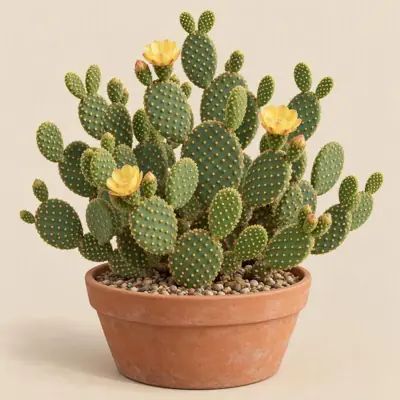
Opuntia microdasys is a perennial, highly branched, shrubby or low-clumping cactus that can grow from creeping to nearly upright. It has an opuntioid (pad-forming) growth form.
Overview
Opuntia microdasys is a perennial, highly branched, shrubby or low-clumping cactus that can grow from creeping to nearly upright. It has an opuntioid (pad-forming) growth form.
Origin and habitat
It is native to central and northern Mexico, with accounts listing Coahuila, Hidalgo, Jalisco, Nuevo León, Querétaro, San Luis Potosí, Tamaulipas, and Zacatecas; sources differ on the native range. It is reported from desert hills, highlands, and xeric scrub in arid to semi-arid areas, growing in sandy to loamy calcareous soils. It is adapted to arid to semi-arid, low-humidity conditions, tolerates drought, and has limited frost tolerance.
Characteristics
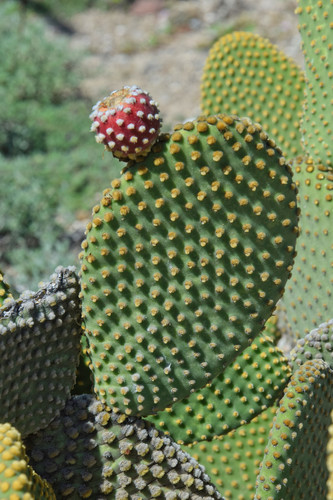
Sources differ on mature size, giving a height of about 50–100 cm and, from few sources, a spread of about 120–150 cm. Sources differ in describing its growth as slow and its flowers as yellow to pale yellow, sometimes with reddish tones; flowering is less frequent in cultivation, and the flowering season is summer. Sources differ in describing the nearly spherical fruit, which becomes dark red or red to purple when mature; one account describes many areoles with dense glochids on the fruit, while another describes white flesh containing many seeds. The plant consists mainly of pale- to medium-green, flattened, elliptic to nearly round, leaf-like stem segments.
Light
It mainly takes full sun but can also accept partial shade; indoors it needs bright light.
Watering
It is drought tolerant and should be grown in a fast-draining medium that is allowed to dry between waterings; watering is greatly reduced during winter dormancy, while prolonged wetness is avoided because it can cause root rot.
Humidity and airflow
It is generally reported to prefer low humidity and need good airflow.
Temperature and dormancy
Sources differ on cold limits, with a reported minimum of about -7 °C; another single source gives about 15 °C as a cold minimum. Sources differ on its hardiness classification and describe it as frost tender; keep above freezing. It rests cool in winter with a little water. A single source reports that it is not frost tolerant.
Growing medium and mounting
It needs a well-drained cactus medium and can grow in loamy or sandy soil; a fast-draining loam-based substrate with coarse sand is also recommended, and the medium may be acidic, neutral, or alkaline. It needs a fast-draining mix.
Feeding
A single source reports that balanced liquid fertilizer can be applied during active growth in spring, summer, and early autumn, with feeding stopped during winter dormancy.
Propagation
It can be propagated by cuttings from stem segments and can also be raised from seed in spring after the seeds are soaked.
Common problems
Mealybugs and scale insects are generally reported as common pests and may occur on the flowers and plant surfaces. Poor drainage or excessive or improper watering can cause root rot. The glochids detach very easily and can adhere to skin or clothing or enter the eyes. It is sensitive to frost and low temperatures and favors dry, low-humidity conditions; in cold areas it needs to be brought indoors or protected from frost.
Identification
It has flattened, segmented, elliptic to nearly round stem segments; sources differ in describing it as usually lacking true spines, while its areoles are densely covered with white, yellow, golden-yellow, or brown glochids. The stem segments often grow in pairs, producing a rabbit-ear-like appearance.
Photos


Sources
- GBIF Backbone: Opuntia microdasys (Lehm.) Pfeiff. — CC BY 4.0 · link
- Wikipedia (en): Opuntia microdasys — CC BY-SA 4.0 · link
- 維基百科:黄毛仙人掌 — CC BY-SA 4.0 · link
- Wikipedia (de): Opuntia microdasys — CC BY-SA 4.0 · link
- Wikipedia (fr): Opuntia microdasys — CC BY-SA 4.0 · link
- Wikipedia (es): Opuntia microdasys — CC BY-SA 4.0 · link
- NC State Plant Toolbox: Opuntia microdasys — copyright (facts only) · link
- Wikipedia (nl): Opuntia microdasys — CC BY-SA 4.0 · link
- LLIFLE Encyclopedia of living forms: Opuntia microdasys — CC BY-SA · link
- RHS Plants: Opuntia microdasys — © RHS, facts only · link
- USDA PLANTS Database: Opuntia microdasys — Public domain (US Government work) · link
- Desert-Tropicals: Opuntia microdasys — © Philippe Faucon (desert-tropicals.com), facts only · link
- 臺北典藏植物園 植物資料庫: Opuntia microdasys — © 臺北典藏植物園, facts only · link
- Top Tropicals catalog: Opuntia microdasys — © Top Tropicals LLC (facts only) · link