
oregano (Origanum vulgare)
Origanum vulgare is an aromatic, branching perennial herb to subshrub that can become woody at the base, with stems that are often four-angled. It is perennial, although it is sometimes grown as an annual in colder regions.
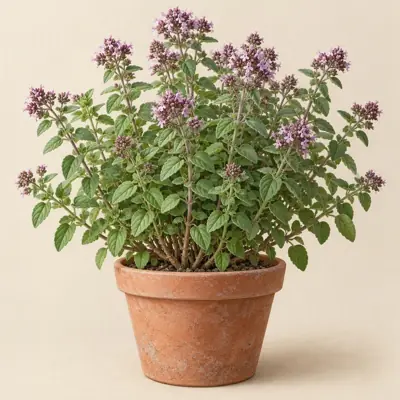
Overview
Origanum vulgare is an aromatic, branching perennial herb to subshrub that can become woody at the base, with stems that are often four-angled. It is perennial, although it is sometimes grown as an annual in colder regions.
Origin and habitat
Sources differ on its native range: major sources place it from Europe and the Mediterranean region through western Eurasia into parts of Asia, while other compiled records also include North Africa, West Asia, Central Asia, the Caucasus and Siberia, and TaiCOL regards populations in Taiwan as native. It occurs in dry grassland, scrub, hillside grassland, roadsides, rocky ground, wasteland and woodland edges, with some sources noting an association with calcareous soils. It prefers sunny, relatively warm and dry conditions, has some cold and drought tolerance, and does not favor hot, humid or persistently wet conditions.
Characteristics
Sources differ on mature height, placing it at about 20–90 cm, while mature spread is 50–100 cm. Sources describe the opposite leaves somewhat differently; they are generally ovate to elongated ovate and green to dark green, may be hairy or gland-dotted, and can have entire to slightly toothed margins. Sources differ somewhat in their descriptions of the small tubular or lipped flowers, which are commonly pink, pale purple, purplish red or white and form dense terminal or branched clusters; flowering occurs mainly from summer into early autumn. The fruit is reported to be a small ovoid nutlet.
Light
Full sun is preferred, although some horticultural varieties can accept partial sun.
Watering
Keep conditions on the dry to moderately moist side with good drainage; after establishment, avoid excessive drying as well as prolonged wetness or waterlogging.
Humidity and airflow
It is generally reported to prefer low humidity and need good airflow.
Temperature and dormancy
Sources differ, with limited evidence indicating a minimum temperature of about -20 °C. Sources differ in their hardiness classifications, while Origanum vulgare is described as frost hardy.
Growing medium and mounting
Well-drained, relatively dry soil is preferred; it can grow in sandy loam, loam and chalky soils and tolerate relatively poor soil, while some sources indicate a preference for slightly alkaline or calcareous conditions.
Feeding
Fertilizer needs are low, and the plant can grow in relatively poor soil with sufficient sun; excessive fertilizer may increase the risk of leaf spotting and weaken its aroma.
Propagation
It is reported to be propagated by seed, division in spring, or cuttings in early summer.
Common problems
High humidity, overly dense growth or excessive fertilizer is reported to be associated with bacterial- or mold-related leaf spotting that can produce black spots on the leaves. High humidity and prolonged rain are reported to cause persistently damp conditions, weakening the plant and potentially causing dieback from the base; insufficient light, prolonged rain or excessive fertilizer may also weaken its aroma. It tolerates drought and cold but does not favor prolonged rain, high humidity or persistently wet conditions.
Identification
It is reported to have a distinct aroma throughout the plant, often four-angled hairy stems, opposite leaves and small clustered flowers; its essential oil can contain carvacrol and thymol.
Photos


Sources
- Wikipedia (en): Oregano — CC BY-SA 4.0 · link
- 維基百科:牛至 — CC BY-SA 4.0 · link
- Wikipedia (ja): オレガノ — CC BY-SA 4.0 · link
- Wikipedia (de): Oregano — CC BY-SA 4.0 · link
- Wikipedia (fr): Origan — CC BY-SA 4.0 · link
- Wikipedia (es): Origanum vulgare — CC BY-SA 4.0 · link
- GBIF descriptions: Database of Vascular Plants of Canada (VASCAN); Catálogo de Plantas y Líquenes de Colombia; DAISIE - — per dataset · link
- NC State Plant Toolbox: Origanum vulgare — copyright (facts only) · link
- Wikipedia (it): Origanum vulgare — CC BY-SA 4.0 · link
- TaiCOL 臺灣物種名錄: Origanum vulgare — CC BY 4.0 · link
- Useful Tropical/Temperate Plants: Origanum vulgare — CC BY-NC-SA 3.0 (facts only) · link
- RHS Plants: Origanum vulgare — © RHS, facts only · link
- USDA PLANTS Database: Origanum vulgare — Public domain (US Government work) · link
- Top Tropicals catalog: Origanum vulgare — © Top Tropicals LLC (facts only) · link