
Spiky Babooncabbage (Othonna euphorbioides)
Othonna euphorbioides is a low, spiny succulent shrub with a tuberous stem base and is usually wider than tall. Sources differ on its description as a perennial.
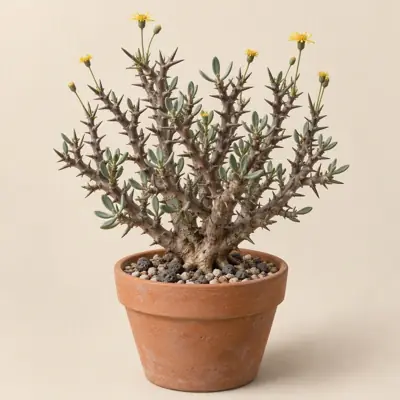
Overview
Othonna euphorbioides is a low, spiny succulent shrub with a tuberous stem base and is usually wider than tall. Sources differ on its description as a perennial.
Origin and habitat
It is reported to be native to Northern Cape, South Africa, in central and northern Namaqualand from around Steinkopf to Kamieskroon and extending farther west. It is reported to grow on exposed, difficult-to-access solid granite domes, crowded into small horizontal crevices on steep rock faces where very little soil is present. Its native habitat is reported to have cold weather during the growing period, with temperatures sometimes falling below freezing.
Characteristics
A specialist source reports a mature height of about 10–30 cm; sources are few. The fleshy, pale green leaves are clustered among dense spines at the branch tips, are long and spoon-shaped, and have a white powdery coating. Flowers in the genus Othonna are generally reported to be yellow and daisy-like, with a few kinds having purple flowers. The plant is reported to have a tuber and is usually wider than tall.
Light
It grows in full sun to partial sun; cultivation close to the strong light and harsh conditions of its native habitat is recommended to maintain a compact form.
Watering
A specialist source recommends relatively harsh cultivation conditions resembling its native habitat, where plants can grow in rock crevices with very little soil.
Temperature and dormancy
Sources differ on a minimum temperature of about 0 °C. It tolerates brief light frost. It is generally reported to drop its leaves and go dormant, with dormancy triggered by heat. A source reports a cold minimum of about 0 °C; sources are few.
Common problems
Its native habitat is reported to be highly exposed and to experience temperatures below freezing during the growing season; cultivation resembling its natural conditions is recommended to maintain a compact form. A specialist source reports that conditions too different from its native habitat may make its compact form difficult to maintain.
Identification
Othonna euphorbioides has a potato-like tuberous stem base and sparse short branches with a gray-white powdery surface, along with branching spines that may retain dried flower parts; overall it forms a compact, succulent, spiny plant resembling a spiny Euphorbia.
Sources
- Wikipedia (en, genus): Othonna — CC BY-SA 4.0 · link
- LLIFLE Encyclopedia of living forms: Othonna euphorbioides — CC BY-SA · link
- The Succulent Plant Page: Othonna (genus-level) — © R.J. Hodgkiss, facts only · link
- PUKUBOOK: Othonna euphorbioides — CC BY-NC (facts only) · link
- Othonna euphorbioides | Giromagi cactus and succulents for sale | Buy plants onl (www.giromagi.com) — facts only (§12) · link