
Wood sorrel (Oxalis triangularis)
Oxalis triangularis is a perennial, clump-forming, rhizomatous herb without an obvious above-ground stem and may be grown as an indoor potted plant, a container plant, or an ornamental garden plant in warm regions.
Overview
Oxalis triangularis is a perennial, clump-forming, rhizomatous herb without an obvious above-ground stem and may be grown as an indoor potted plant, a container plant, or an ornamental garden plant in warm regions.
Origin and habitat
It is native to South America, with accounts including Brazil, Bolivia, Argentina, and Paraguay, while some horticultural sources describe its range as extending from Peru to Brazil and northern Argentina; sources differ on the exact range. One source reports it growing among rocks near streams in the Rio de Janeiro area of Brazil at a stated elevation. In horticulture it can be grown outdoors in warm regions, while in colder regions it is commonly kept indoors and protected from severe frost.
Characteristics
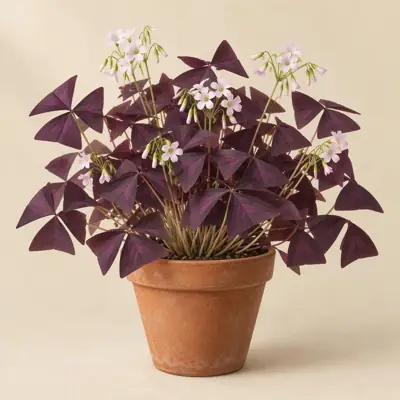
Sources differ on mature height, placing it at about 10–50 cm, while mature spread is 10–50 cm. Leaves arise from underground rhizomes on long petioles and are divided into obtriangular to obovate-triangular leaflets; wild plants may be green, while cultivated forms are often deep burgundy to purple, and the leaves open and close with light, closing at night and when disturbed. The flowers are white to pale pink and are usually borne in clusters or umbels; they also close at night, and sources differ in describing flowering from spring through autumn or mainly from spring through summer. The fruit is reported to be a capsule containing multiple seeds, splitting when mature and dispersing them.
Light
Sources differ somewhat on light: bright conditions with partial sun, bright indirect light, or light shade are described, while some sources also allow full sun but advise avoiding excessively strong sunlight that causes the leaves to close.
Watering
Use a well-drained growing medium and generally water after the surface has dried; reduce watering during dormancy, with some sources specifically recommending no winter watering. The stated winter watering interval is 30–90 days.
Temperature and dormancy
Sources are few or differ on temperature limits, giving a minimum of about -5 °C and a maximum of about 27 °C. Sources differ on the stated hardiness range and on when the plant generally needs to be grown indoors in colder zones. It is reported to tolerate brief light frost.
Growing medium and mounting
A well-drained growing medium is suitable, including loamy, sandy, or humus-rich soil; it is also described as adapting to acidic, neutral, or alkaline soil.
Feeding
One source suggests that feeding is unnecessary before flowering and that a suitable fertilizer may be provided after flowering.
Propagation
It can be propagated by seed or division, including division of the rhizome, and propagation from rhizome scales is also described.
Common problems
Outdoor plants are reported to be susceptible to damage from slugs and snails, and rust may occur. Prolonged high temperatures may lead to early dormancy or a weakened appearance, and overly dry conditions may also trigger dormancy; another reported concern is that mature fruits split and disperse seeds, allowing spread where conditions are suitable. Severe frost is a concern, so plants in cold regions are best moved indoors; some subspecies or mature plants may briefly tolerate light frost.
Identification
Its conspicuous triangular leaflets give the foliage a butterfly-like or clover-like appearance, cultivated forms often have purple leaves, and the leaves show light- and night-responsive opening and closing movements.
Photos


Sources
- Wikipedia (en): Oxalis triangularis — CC BY-SA 4.0 · link
- 維基百科:南美三角酢浆草 — CC BY-SA 4.0 · link
- Wikipedia (de): Oxalis triangularis — CC BY-SA 4.0 · link
- Wikipedia (fr): Oxalis triangularis — CC BY-SA 4.0 · link
- Wikipedia (es): Oxalis triangularis — CC BY-SA 4.0 · link
- GBIF descriptions: Manual of the Alien Plants of Belgium; Lista de especies de plantas exóticas y trasplantadas de Colo — per dataset · link
- NC State Plant Toolbox: Oxalis triangularis — copyright (facts only) · link
- Wikipedia (it): Oxalis triangularis — CC BY-SA 4.0 · link
- Useful Tropical/Temperate Plants: Oxalis triangularis — CC BY-NC-SA 3.0 (facts only) · link
- RHS Plants: Oxalis triangularis — © RHS, facts only · link
- Top Tropicals catalog: Oxalis triangularis — © Top Tropicals LLC (facts only) · link