
peppermint rock oxalis (Oxalis versicolor)
Oxalis versicolor is a bulbous, clump-forming herbaceous perennial.
Overview
Oxalis versicolor is a bulbous, clump-forming herbaceous perennial.
Origin and habitat
Oxalis versicolor is native to South Africa, with Japanese sources further placing its native range in the Cape region of South Africa. In the United Kingdom, it can overwinter fully outdoors only in milder or coastal areas, and cultivation in a sheltered position is recommended.
Characteristics
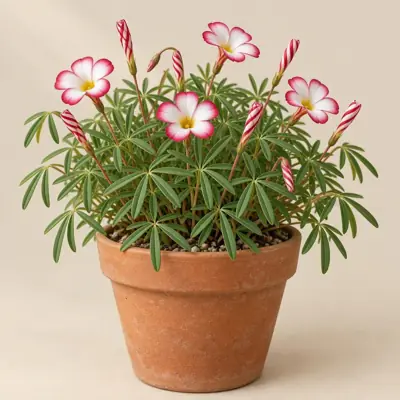
Sources differ on mature height, placing it at about 8–15 cm; a single source reports a mature spread of about 0–10 cm. The leaves range from pale to bright green and are trifoliate, with narrow, linear leaflets. The flowers are funnel-shaped or tubular, with petals joined at the base; they are mainly white, with scarlet, red, or deep pink edging on the outer or rear surfaces, producing conspicuous red-and-white stripes when the buds are closed, and the flowers open in ample sunlight and close in dim conditions. Sources differ on the flowering season, describing it as extending from late summer into winter; a single source reports small capsules enclosed by the calyx and containing many seeds.
Light
Oxalis versicolor grows in full sun to partial shade, and ample sunlight helps the flowers open fully.
Watering
The growing medium should be well drained; Japanese sources recommend stopping watering after summer dormancy begins and moving the plant to a shaded position.
Temperature and dormancy
A single source reports a minimum temperature of about -5 °C, so evidence for this figure is limited. Hardiness is described as USDA and RHS classifications, and a single source generally describes Oxalis versicolor as frost hardy.
Growing medium and mounting
Oxalis versicolor prefers fertile, well-drained soil, including loamy or sandy soil; RHS describes neutral to alkaline conditions as suitable and also recommends well-drained sandy or humus-rich soil.
Propagation
Oxalis versicolor can be propagated by seed or division, including by separating small bulbs that form around the parent bulb.
Common problems
When grown outdoors, Oxalis versicolor is reported to be susceptible to damage from slugs and snails. It is reported to be susceptible to rust. Flowers remain closed when light is insufficient or the weather is dim. Cold tolerance is limited, and RHS recommends a sheltered position.
Identification
The white petals have red to deep pink edging on their backs, and when the flowers are closed they form a candy-cane-like red-and-white spiral stripe pattern that is their most distinctive feature.
Photos

