
Guiana-chestnut (Pachira aquatica)
Sources differ in describing Pachira aquatica as a large evergreen tree and as a large indoor potted foliage plant. It is reported to be perennial.
Overview
Sources differ in describing Pachira aquatica as a large evergreen tree and as a large indoor potted foliage plant. It is reported to be perennial.
Origin and habitat
Pachira aquatica is native to tropical America, from Mexico and Central America into South America, including northern Brazil and Bolivia. It naturally occurs in tropical wetlands, including freshwater swamps, riverbanks, estuaries, lowland rainforest, and moist riparian areas. It is a humid tropical plant adapted to warm, highly humid conditions.
Characteristics
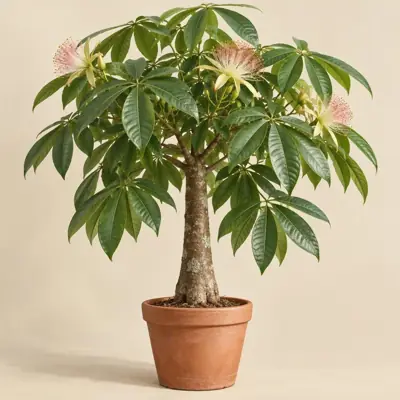
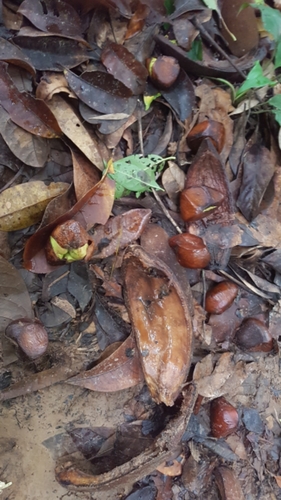
Sources differ on mature height, placing it at about 100–244 cm, while a single source reports a mature spread of about 10–50 cm. It is reported to grow at a moderate to fast rate. The leaves are glossy green to dark green, palmately compound, with leaflets that may be lance-shaped, obovate, or elliptic and somewhat leathery. The flowers are large, conspicuous, and fragrant, with narrow petals and numerous long stamens in yellow, orange-yellow, white-red, or golden-red tones; mature indoor potted plants seldom flower, while flowering and fruiting patterns vary among locations and tropical cultivation accounts. The fruit is a large capsule that becomes brown and woody when mature and contains round brown seeds.
Light
Indoors, Pachira aquatica is suited to bright indirect light or partial shade; some outdoor information indicates that it can also grow from full sun to partial shade, although strong direct light may scorch the leaves.
Watering
Potted plants are watered moderately, with the growing medium kept moist but well drained; although the species is native to wetlands, established plants also have some drought tolerance.
Temperature and dormancy
Sources differ, with limited information placing the minimum temperature at about 5 °C. A single source reports a USDA hardiness classification for the plant.
Growing medium and mounting
For containers, a loose, well-drained growing medium is suitable; RHS indicates a well-drained loam-based medium that may be acidic, neutral, or alkaline, while field and tropical cultivation information also records growth in clay, sandy, or sandy-clay soils.
Propagation
Pachira aquatica is reported to be propagated by seed, semi-ripe cuttings, or air layering.
Common problems
It is reported to be affected by scale insects, glasshouse red spider mites, and aphids, and leaf spot may occur. Strong direct sunlight indoors is reported to cause leaf scorch, and potted plants generally do not flower readily. As a warm-tropical plant, it requires indoor overwintering in cold regions; NC State recommends bringing it indoors before temperatures become sufficiently low, and RHS assigns it an H1B greenhouse or indoor hardiness rating.
Identification
It is reported to have a somewhat swollen trunk base or root area that can store water, glossy palmately compound leaves, and large flowers with numerous long stamens. Pachira glabra is reported to be commonly mislabeled as Pachira aquatica in the horticultural trade; the account distinguishes P. glabra by smaller green capsules and white filaments, whereas mature P. aquatica fruits are larger and brown and its filaments have pinkish or reddish tones.
Photos


Sources
- Wikipedia (en): Pachira aquatica — CC BY-SA 4.0 · link
- 維基百科:馬拉巴栗 — CC BY-SA 4.0 · link
- Wikipedia (de): Pachira aquatica — CC BY-SA 4.0 · link
- Wikipedia (fr): Pachira aquatica — CC BY-SA 4.0 · link
- Wikipedia (es): Pachira aquatica — CC BY-SA 4.0 · link
- GBIF descriptions: Catálogo de Plantas y Líquenes de Colombia; Plantas vasculares que se han reportado en los bosques s — per dataset · link
- NC State Plant Toolbox: Pachira aquatica — copyright (facts only) · link
- Useful Tropical/Temperate Plants: Pachira aquatica — CC BY-NC-SA 3.0 (facts only) · link
- RHS Plants: Pachira aquatica — © RHS, facts only · link
- USDA PLANTS Database: Pachira aquatica — Public domain (US Government work) · link