
Pachypodium densiflorum (Pachypodium densiflorum)
Pachypodium densiflorum is a perennial, low-growing, many-branched caudiciform succulent shrub.
Overview
Pachypodium densiflorum is a perennial, low-growing, many-branched caudiciform succulent shrub.
Origin and habitat
Pachypodium densiflorum is native to Madagascar. It grows mainly in rocky habitats, including granite outcrops and rock crevices, and is also described from dry scrub or desert-type biomes. It is adapted to dry conditions, with an enlarged stem base that stores water through drought.
Characteristics
Sources differ on mature height, with a figure of about 70 cm reported; its mature spread is 0–200 cm, while overall growth is described variously as slow to moderate. The deciduous leaves are clustered near branch tips, dark green to dark olive green, elliptical to obovate or lanceolate, paler and hairy beneath; sources differ in their descriptions. Numerous flowers occur in clusters and are mainly yellow, sometimes with orange or darker tones, with a lobed corolla; sources differ on the reported spring flowering season. The horn-shaped fruits commonly occur in pairs and contain seeds, and the plant is reported to develop a thickened trunk (pachycaul) with a large tuberous trunk.
Light
Grow Pachypodium densiflorum in full sun to bright partial sun, in a position with good sunlight and ventilation.
Watering
During active growth, water thoroughly after the medium has dried; regular watering may be given in warm summer conditions provided drainage is good, while watering should be greatly reduced during cool periods and may be withheld during winter dormancy to avoid rot associated with cold, wet conditions. It is generally reported that while in leaf, water when the mix has dried, and withhold water while leafless.
Humidity and airflow
It is generally reported to prefer low humidity and need good airflow.
Temperature and dormancy
Sources differ on the minimum temperature, with about 3 °C reported from few sources. Sources differ on its hardiness classification, while it is described as frost tender and should be kept above freezing. It drops its leaves and goes dormant, with dormancy triggered by cold. It is generally reported to have high heat tolerance.
Growing medium and mounting
Pachypodium densiflorum needs a well-drained succulent or cactus medium; another source recommends a mixture of small-grained akadama, small-grained kanuma, small-grained pumice and leaf mold. It needs a fast-draining mix.
Feeding
Fertilize during active growth; sources recommend slow-release or diluted liquid fertilizer in spring and autumn, or half-strength balanced fertilizer for container-grown plants during active growth.
Propagation
Propagation is mainly by seed, while cuttings may also be attempted in limited amounts but are difficult to root. Fresh seed may be soaked in warm water before sowing, and germination is reported to begin quickly under warm conditions but may continue over an extended period.
Common problems
Aphids are generally reported as a pest, particularly during flowering. Soft rot is generally reported, and root injury and excessively wet conditions may increase problems with decay. Cold, wet conditions, overwatering or poor drainage can readily cause rot, while root wounds from repotting can allow pathogens to enter. It is sensitive to frost and cold, wet conditions; in cold regions the tuberous base requires protection from frost, and strong winds should be avoided.
Identification
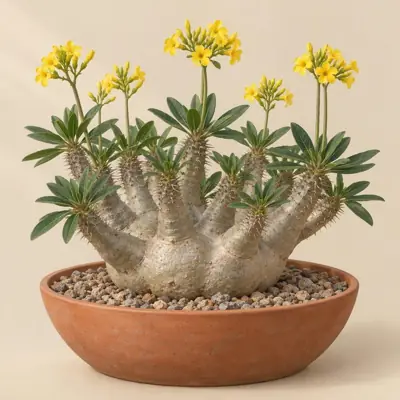
Pachypodium densiflorum has a conspicuously swollen, silvery-gray, fleshy tuberous base, with several short spiny branches arising from the base, especially conspicuous spines on young shoots, and numerous yellow flowers.
Photos


Sources
- GBIF Backbone: Pachypodium densiflorum Baker — CC BY 4.0 · link
- Wikipedia (en): Pachypodium densiflorum — CC BY-SA 4.0 · link
- Wikipedia (de): Pachypodium densiflorum — CC BY-SA 4.0 · link
- Wikipedia (es): Pachypodium densiflorum — CC BY-SA 4.0 · link
- LLIFLE Encyclopedia of living forms: Pachypodium densiflorum — CC BY-SA · link
- Desert-Tropicals: Pachypodium densiflorum — © Philippe Faucon (desert-tropicals.com), facts only · link
- The Succulent Plant Page: Pachypodium (genus-level) — © R.J. Hodgkiss, facts only · link
- NHK みんなの趣味の園芸 植物図鑑: Pachypodium densiflorum — © NHK出版, facts only · link
- Top Tropicals catalog: Pachypodium densiflorum — © Top Tropicals LLC (facts only) · link
- Pachypodium densiflorum | Giromagi Cactus and Succulents for sale | Buy plants o (www.giromagi.com) — facts only (§12) · link
- PUKUBOOK: Pachypodium densiflorum — CC BY-NC (facts only) · link