
Elephant's Foot Plant (Pachypodium rosulatum)
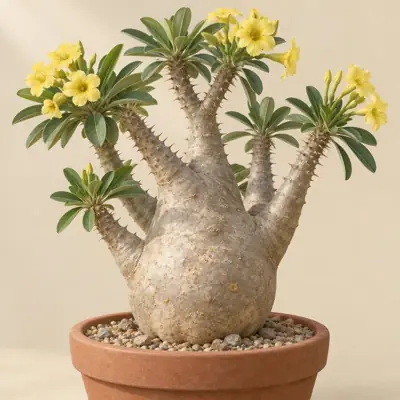
Pachypodium rosulatum is a shrubby caudiciform succulent with a swollen, bottle-shaped stem and cylindrical branches. It is perennial and may shed its leaves and become dormant during the dry season or winter.
Overview
Pachypodium rosulatum is a shrubby caudiciform succulent with a swollen, bottle-shaped stem and cylindrical branches. It is perennial and may shed its leaves and become dormant during the dry season or winter.
Origin and habitat
Sources differ on the details of its distribution, but describe Pachypodium rosulatum as endemic to Madagascar, including the central highlands and areas such as Mahajanga and Toliara, with different subspecies extending into western, northwestern, north-central, southeastern, and south-central regions. It inhabits dry, sunny rocky ground and stony slopes in arid habitats. It is adapted to hot, dry conditions and prolonged water shortage, storing water in its fleshy stems and underground tuber; its native habitat can experience temperatures below freezing in winter, while cold and wet conditions can cause problems in cultivation.
Characteristics
Sources differ on mature height, with about 150–300 cm reported; few sources report a mature spread of about 200–300 cm. Sources differ in describing its growth rate as slow to moderate, while broader size accounts describe it as a shrub capable of becoming substantial in both height and crown spread. The deep green, stalked leaves form rosettes at branch tips and may be narrowly oblanceolate, ovate, or elliptic; they are deciduous and fall during dormancy. It has a swollen stem and yellow to sulfur-yellow flowers with elongated floral structures, borne in inflorescences near the upper parts of the branches; the fruits contain slender seeds.
Light
It grows in full sun to bright partial sun and needs bright light indoors.
Watering
During growth, water should be controlled and the growing medium kept well drained, avoiding waterlogging; watering is gradually reduced in autumn, and the plant is kept dry or watering is stopped during winter dormancy because cold, wet conditions can lead to rot. It is generally reported that while in leaf, water when the mix has dried. Withhold water while leafless.
Humidity and airflow
It is generally reported to prefer low humidity and need good airflow.
Temperature and dormancy
Sources differ on the minimum temperature, with about 5 °C reported from few sources. Sources differ on its hardiness-zone classification. It is frost tender and should be kept above freezing, while also having high heat tolerance. It drops its leaves and goes dormant, with dormancy triggered by cold.
Growing medium and mounting
Use a coarse, porous, fast-draining cactus-type medium that is not strongly acidic; suitable well-drained mixtures may include akadama, kanuma, pumice, and leaf mold. It is reported to need a very fast-draining mix.
Feeding
It is reported that fertilizer may be applied during spring and autumn growth, using either slow-release chemical fertilizer at the specified amount or liquid fertilizer diluted as directed.
Propagation
Propagation is mainly by seed, with cuttings also used to a lesser extent; fresh seed germinates well.
Common problems
Aphids are reported as pests, particularly during flowering, and soft rot is reported, with excessive moisture or root injury during repotting potentially increasing its risk. Cold, wet conditions can promote rot, and poor drainage and excessive winter watering should be avoided. In cultivation it is sensitive to frost and cold, wet winter conditions; freezing should be avoided and it should be kept dry during cold periods.
Identification
Pachypodium rosulatum can be recognized by its bottle-shaped, silver-gray to gray-green swollen stem, which is mostly sparsely spined or nearly spineless at the base, together with cylindrical branches bearing stout spines, rosettes of leaves at the branch tips, and yellow flowers.
Photos


Sources
- Wikipedia (en): Pachypodium rosulatum — CC BY-SA 4.0 · link
- Wikipedia (de): Pachypodium rosulatum — CC BY-SA 4.0 · link
- Wikipedia (fr): Pachypodium rosulatum — CC BY-SA 4.0 · link
- Wikipedia (es): Pachypodium rosulatum — CC BY-SA 4.0 · link
- LLIFLE Encyclopedia of living forms: Pachypodium rosulatum — CC BY-SA · link
- The Succulent Plant Page: Pachypodium (genus-level) — © R.J. Hodgkiss, facts only · link
- NHK みんなの趣味の園芸 植物図鑑: Pachypodium rosulatum — © NHK出版, facts only · link
- Top Tropicals catalog: Pachypodium rosulatum — © Top Tropicals LLC (facts only) · link
- Pachypodium rosulatum | Giromagi cactus and succulents for sale | Buy plants onl (www.giromagi.com) — facts only (§12) · link
- PUKUBOOK: Pachypodium rosulatum — CC BY-NC (facts only) · link