
balloon cactus (Parodia magnifica)
Parodia magnifica is a perennial evergreen with a globular form, often solitary at first, becoming short-cylindrical with age and capable of forming clumps.
Overview
Parodia magnifica is a perennial evergreen with a globular form, often solitary at first, becoming short-cylindrical with age and capable of forming clumps.
Origin and habitat
Sources differ on its native range: it is centered in southern Brazil, especially Rio Grande do Sul, while some accounts also include Uruguay and neighboring Paraguay and Argentina. It naturally grows in hills or temperate grasslands, on steep rock faces and in crevices, and under the shade of larger plants in deciduous forest; habitats are well drained, and populations are sparse and fragmented. Its native environment has warm and cool seasons and is generally dry and well drained; winter nights may approach freezing, while cultivation information generally recommends avoiding frost.
Characteristics
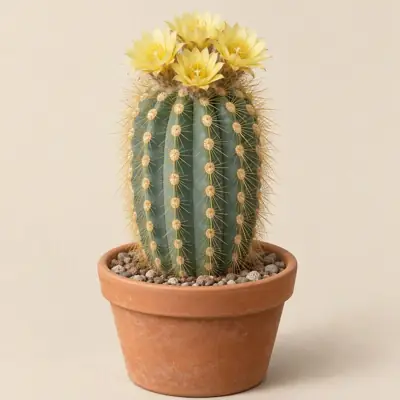
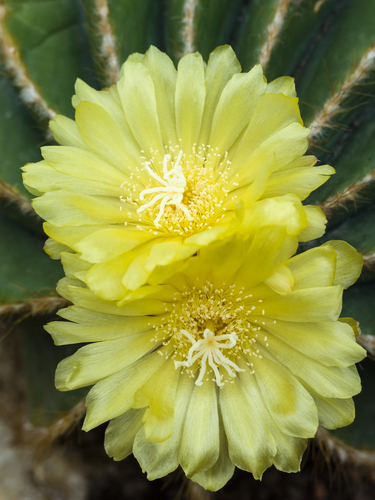
Sources differ on mature height, placing it at about 7–30 cm, while mature spread is 10–50 cm. It is reported to grow relatively quickly and to form clumps readily under favorable conditions. Sources differ in descriptions of the flowers, which are borne at the stem apex, are funnel-shaped, and range from sulfur yellow to pale yellow. Sources differ on flowering time, describing flowering from summer into early autumn with possible repeat flowering during the warm season; the fruit is globular and pink, containing reddish-brown, obovate to club-shaped seeds with a tuberculate surface.
Light
Parodia magnifica takes full sun to bright partial shade; ample sunlight supports flowering, but sudden or excessively strong exposure during hot summers should be avoided to prevent sunburn.
Watering
Water moderately during the growing season with good drainage and do not allow water to collect around the roots; greatly reduce watering in winter, keeping conditions nearly dry or only slightly moist.
Humidity and airflow
It is reported to need good airflow.
Temperature and dormancy
Sources differ on the minimum temperature, with the limited information placing it at about 10 °C; a separate single source gives a cold minimum of about 0 °C. The ideal temperature is 19–24 °C. It is frost tender; keep above freezing, and it is not frost tolerant. It rests cool and dry in winter, and hardiness-zone information places it within a warm-zone range.
Growing medium and mounting
It needs a well-drained, aerated cactus medium that may contain sandy, loamy, or mineral components, and it prefers slightly acidic to neutral conditions. It is reported to need a very fast-draining mix.
Feeding
Feed during the growing season; suitable options include a high-potassium cactus and succulent fertilizer containing trace elements or a low-nitrogen liquid fertilizer applied periodically from mid-spring to late summer.
Propagation
Sources differ on propagation methods: seed is documented, while other accounts also describe cuttings or separating offsets. Documented propagation methods include seed and cuttings, as well as propagation by offsets.
Common problems
Potential pests include mealybugs and aphids, while genus-level information for Parodia also lists spider mites and whiteflies. Disease is generally uncommon, but waterlogging or excessive watering can lead to root rot and fungal infection. Major cultivation problems include root rot from waterlogging and sunburn caused by intense light, high temperatures, or a sudden move from shade into full sun. In cultivation it should be protected from frost and freezing, while intense summer exposure can also cause sunburn.
Identification
The stem is blue-green to gray-blue-green, initially globular and later potentially short-cylindrical, with prominent straight ribs and densely set areoles. Its spines are slender and yellow, while the stem apex may bear white wool and vivid yellow flowers.
Photos


Sources
- Wikipedia (en): Parodia magnifica — CC BY-SA 4.0 · link
- Wikipedia (de): Parodia magnifica — CC BY-SA 4.0 · link
- Wikipedia (fr): Parodia magnifica — CC BY-SA 4.0 · link
- Wikipedia (es): Parodia magnifica — CC BY-SA 4.0 · link
- LLIFLE Encyclopedia of living forms: Parodia magnifica — CC BY-SA · link
- RHS Plants: Parodia magnifica — © RHS, facts only · link
- Desert-Tropicals: Parodia magnifica — © Philippe Faucon (desert-tropicals.com), facts only · link
- 臺北典藏植物園 植物資料庫: Parodia magnifica — © 臺北典藏植物園, facts only · link
- NC State Plant Toolbox: Parodia (genus-level) — copyright (facts only) · link
- Top Tropicals catalog: Parodia magnifica — © Top Tropicals LLC (facts only) · link
- PUKUBOOK: Parodia magnifica — CC BY-NC (facts only) · link