
Cauliflower Storksbill (Pelargonium alternans)
Pelargonium alternans is a compact, deciduous, multi-stemmed succulent to semi-succulent small shrub with fleshy stems. It is reported to be perennial.
Overview
Pelargonium alternans is a compact, deciduous, multi-stemmed succulent to semi-succulent small shrub with fleshy stems. It is reported to be perennial.
Origin and habitat
It is native to southern South Africa, with records mainly from western and southern parts of the southwestern Cape Province. It is reported to grow in the Succulent Karoo, with roots suited to growing among rocks in substrates that can include shale, quartzite, diabase, granite, and tillite. Its native habitat is reported to have hot summers and rainfall concentrated mainly in winter, and the plant is drought tolerant.
Characteristics
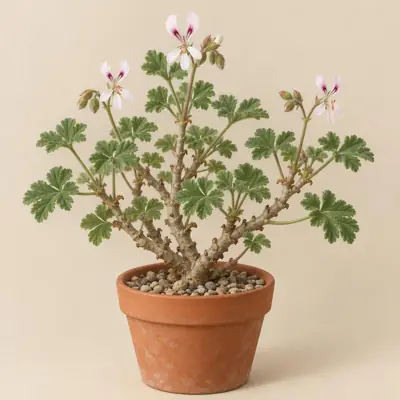
Sources differ on mature height, giving about 40–50 cm, while the few sources for spread report about 50–60 cm. Sources differ in their descriptions of the small, hairy, glandular, deeply divided compound leaves; the leaflets are generally alternate and wedge-shaped, with deeply divided or lobed forms and margins that may be wavy or rounded-toothed, while the scented foliage varies among plants and is seasonally shed. The flowers are white to very pale pink, with red lines near the center of the upper petals, red to orange-red anthers and pollen, and a nighttime fragrance; flowers are borne in terminal clusters. Sources differ on flowering time, describing it from late autumn to early summer and noting that cultivated plants may flower throughout the year, more strongly in autumn and early summer; the plant is also reported to have a swollen root.
Light
Sources differ, but bright shade or morning sun is described as suitable in summer, and the general full-sun requirement for Pelargonium should not simply replace the seasonal requirements reported for this species.
Watering
Pelargonium alternans is reported to be drought tolerant with low water needs; watering is recommended in autumn and also in spring, while summer and winter are kept dry and overwatering is avoided. It is also generally recommended to withhold water while leafless.
Temperature and dormancy
The few sources differ around a minimum of about 8 °C. It is generally described as frost tender; keep above freezing. It is reported to drop its leaves and go dormant, with dormancy triggered by heat.
Growing medium and mounting
A well-drained mineral growing medium with almost no organic matter is generally recommended; perlite can substitute for pumice, although it is reported to float toward the surface of the medium.
Feeding
Avoiding excessive feeding is generally recommended, as cultivated plants are reported to lose their typical compact form with excessive watering and feeding.
Propagation
Sources differ on propagation details, but propagation by sowing seed or taking cuttings is described; seed may be sown throughout the year, with spring and autumn described as easier, while cuttings are described as preferable in autumn and spring.
Common problems
Excessive watering and feeding are reported to cause growth that departs from the plant's typical compact form. It is drought tolerant but requires protection from frost, while Pelargonium as a genus is described as tolerating only light frost. Pelargonium is reported to be susceptible to mealybugs, scale insects, whiteflies, thrips, caterpillars, and leaf mites, but the sources do not confirm how commonly these occur specifically in Pelargonium alternans. Pelargonium is reported to be susceptible to bacterial wilt, bacterial leaf spot, and gray mold, but the sources provide no disease records specific to Pelargonium alternans.
Identification
Pelargonium alternans has rough, twisted, many-jointed fleshy to semi-woody branches, seasonally deciduous leaves, and white to pale pink flowers with backward-curving upper petals, reddish-purple lines, and orange pollen.
Photos


Sources
- Wikipedia (en, genus): Pelargonium — CC BY-SA 4.0 · link
- Wikipedia (de): Pelargonium alternans — CC BY-SA 4.0 · link
- LLIFLE Encyclopedia of living forms: Pelargonium alternans — CC BY-SA · link
- Desert-Tropicals: Pelargonium alternans — © Philippe Faucon (desert-tropicals.com), facts only · link
- NHK みんなの趣味の園芸 植物図鑑: Pelargonium (genus-level) — © NHK出版, facts only · link
- NC State Plant Toolbox: Pelargonium (genus-level) — copyright (facts only) · link
- PUKUBOOK: Pelargonium alternans — CC BY-NC (facts only) · link