
Fleshy-Stalked Pelargonium (Pelargonium carnosum)
Pelargonium carnosum is a shrubby Pelargonium with thick, succulent stems and a woody, swollen tuber-like rhizome or root structure at the base. It is a deciduous perennial that is dormant or partly dormant in summer.
Overview
Pelargonium carnosum is a shrubby Pelargonium with thick, succulent stems and a woody, swollen tuber-like rhizome or root structure at the base. It is a deciduous perennial that is dormant or partly dormant in summer.
Origin and habitat
Pelargonium carnosum is native to Namibia and South Africa, where it occurs in the Northern Cape, Western Cape, and Eastern Cape. It is reported to grow in rocky crevices, and wild plants may occur beneath the shade of other plants. Its growth rhythm follows winter rainfall, with growth in the cooler season followed by dormancy toward summer.
Characteristics
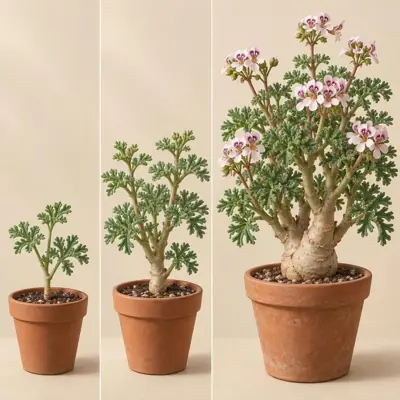
Plants can reach 60 cm in height and have a swollen root. The leaves are deeply pinnately divided along the main midrib into fine segments, giving a fern-like appearance; they are soft, hairy, slightly succulent, and may be gray-green. The small flowers range from creamy pink to pink or scarlet, have markings and narrow petals, and are borne in many-flowered umbels on long flower stalks. The fruit of Pelargonium is generally reported to have an elongated pod-like structure resembling a stork's bill.
Light
Sources differ: the plant is described as accepting full sun to partial sun, while bright shade or morning sun is considered more suitable in summer and strong direct sunlight should be avoided.
Watering
Sources differ on the cultivation watering schedule, but describe supplying water during active periods and keeping the plant completely dry during its summer and winter resting periods; overwatering can produce abnormal growth. A specialist source reports winter watering at intervals of about 30–60 days, but sources are few. Withhold water while leafless.
Humidity and airflow
A specialist source reports that Pelargonium carnosum needs good airflow.
Temperature and dormancy
Sources differ on the minimum temperature, with about 8 °C reported. It is frost tender; keep above freezing. A specialist source reports that it drops its leaves and goes dormant and that dormancy is triggered by heat. A specialist source reports a cold minimum of about 8 °C, but sources are few.
Growing medium and mounting
Sources differ, but describe a well-drained succulent growing medium with very little organic matter; pumice is mentioned, with perlite as an alternative material.
Feeding
Sources differ, but fertilizer needs are described as low, with a low-nitrogen cactus and succulent fertilizer containing trace elements used during the growing season at a reduced concentration. Excess fertilizer may cause excessive vegetative growth and increase the risk of fungal disease.
Propagation
Pelargonium carnosum can be propagated by seed or stem cuttings; sowing in spring or autumn is generally more successful, seeds prefer cooler germination conditions, germination may be uneven and prolonged, and seed-coat treatment can improve it. Information for Pelargonium also indicates that tuberous types can be propagated by root cuttings. A specialist source reports seed and stem cuttings as propagation methods.
Common problems
A specialist source reports that overwatering or overfertilizing are common cultivation problems and that plants grown this way may differ greatly from their normal form; perlite in the medium may also gradually float to the surface. A specialist source reports that it does not tolerate frost and should be protected from it, while winter wetness and strong direct summer sunlight should also be avoided. Pelargonium is reported to be susceptible to pests including mealybugs, scale insects, whiteflies, thrips, spider mites, and caterpillars. Pelargonium may develop fungal and bacterial diseases, including bacterial wilt, bacterial leaf spot, and gray mold; sources also indicate that excessive tender growth caused by overfertilizing Pelargonium carnosum can be more susceptible to fungal disease.
Identification
Pelargonium carnosum has gray-green, coarse, thick succulent stems with a knobby, rugged surface; the base becomes woody and swollen into a tuber-like structure, branching is sparse, and the leaves are concentrated mainly near the branch tips.
Photos


Sources
- Wikipedia (de): Pelargonium carnosum — CC BY-SA 4.0 · link
- LLIFLE Encyclopedia of living forms: Pelargonium carnosum — CC BY-SA · link
- NC State Plant Toolbox: Pelargonium (genus-level) — copyright (facts only) · link
- PUKUBOOK: Pelargonium carnosum — CC BY-NC (facts only) · link
- Pelargonium carnosum | Giromagi cactus and succulents for sale | Buy plants onli (www.giromagi.com) — facts only (§12) · link