
sweet scented geranium (Pelargonium graveolens)
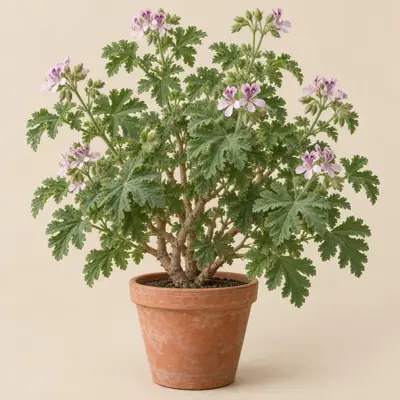
Pelargonium graveolens is an aromatic, upright, much-branched evergreen shrub to subshrub, with younger shoots more herbaceous and older shoots becoming woody. It is generally reported to be perennial.
Overview
Pelargonium graveolens is an aromatic, upright, much-branched evergreen shrub to subshrub, with younger shoots more herbaceous and older shoots becoming woody. It is generally reported to be perennial.
Origin and habitat
It is reported to be native to southern Africa, including South Africa, Zimbabwe, and Mozambique. It is reported to occur in relatively moist, sheltered mountain habitats such as ravines or valleys. It is reported to grow mainly in the subtropical climate of southern Africa and to be widely cultivated from warm-temperate to tropical regions.
Characteristics
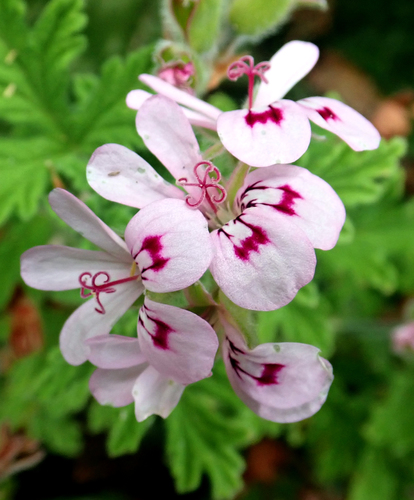
Sources differ on mature height, placing it at about 120–150 cm; a single source reports a mature spread of about 100–100 cm. The leaves are reported to be alternate and stalked, with soft, roughly heart-shaped blades that are deeply palmately divided to multilobed and may have coarsely toothed lobes; the leaves and other above-ground parts bear soft hairs and glandular hairs, giving them a soft to nearly velvety feel. Sources differ in describing the flowers as white to nearly white, pink, or pinkish purple; the upper petals differ in form from the lower petals, and the upper petals may show burgundy to deep red veins. In its native Southern Hemisphere range, it is reported to flower from late winter into summer, with spring as the main flowering period; the fruit has a long, slender form resembling a stork's bill.
Light
Sources differ, but describe a position with abundant sunlight and good ventilation as suitable.
Watering
Its native habitat can be relatively moist, but cultivation calls for good drainage and avoidance of persistently wet, poorly ventilated conditions.
Humidity and airflow
It is generally reported to prefer low humidity and need good airflow.
Temperature and dormancy
It is generally reported to tolerate brief light frost.
Growing medium and mounting
It prefers a light, well-drained soil with a neutral to slightly alkaline reaction.
Feeding
A Spanish-language source reports field fertilization guidance using well-rotted manure during soil preparation, along with nitrogen, phosphate, and potassium.
Propagation
It is reported to propagate from cuttings, which can root in a well-drained medium, and propagation in water is also reported.
Common problems
Horticultural information for the genus Pelargonium generally lists mealybugs, scale insects, whiteflies, and thrips as common pests. Cultivation should generally avoid persistently damp, poorly ventilated conditions associated with prolonged rainfall. It tolerates heat but not prolonged high humidity; frost tolerance is limited, and prolonged freezing or severe cold may kill some cultivated varieties.
Identification
Pelargonium graveolens is aromatic throughout, with abundant glandular hairs, soft deeply divided leaves, and an upright, much-branched habit. Sources differ in describing the wild type's scent with mint, balsam, and rose notes, while cultivated varieties show greater variation in fragrance.
Photos


Sources
- Wikipedia (en): Pelargonium graveolens — CC BY-SA 4.0 · link
- Wikipedia (ja): ニオイテンジクアオイ — CC BY-SA 4.0 · link
- Wikipedia (de): Pelargonium graveolens — CC BY-SA 4.0 · link
- Wikipedia (fr): Pelargonium graveolens — CC BY-SA 4.0 · link
- Wikipedia (es): Pelargonium graveolens — CC BY-SA 4.0 · link
- Wikipedia (it): Pelargonium graveolens — CC BY-SA 4.0 · link
- Useful Tropical/Temperate Plants: Pelargonium graveolens — CC BY-NC-SA 3.0 (facts only) · link
- USDA PLANTS Database: Pelargonium graveolens — Public domain (US Government work) · link
- NC State Plant Toolbox: Pelargonium (genus-level) — copyright (facts only) · link