
Button Fern (Pellaea rotundifolia)
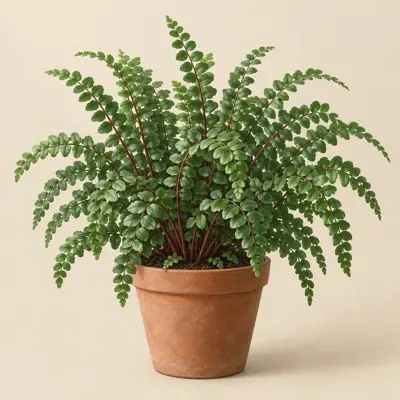
Pellaea rotundifolia is a low, compact, clumping fern with pinnate fronds forming an arching to nearly flat rosette. Sources differ in describing its life cycle, including as a perennial evergreen herbaceous fern. It is reported to be lithophytic.
Overview
Pellaea rotundifolia is a low, compact, clumping fern with pinnate fronds forming an arching to nearly flat rosette. Sources differ in describing its life cycle, including as a perennial evergreen herbaceous fern. It is reported to be lithophytic.
Origin and habitat
Sources differ in accounts of its native range, including New Zealand. It occurs in scrub, forest and moist forest, as well as on cliffs and in rock crevices. It is suited to warm environments without severe frost and can withstand brief cold, but not prolonged conditions below freezing.
Characteristics
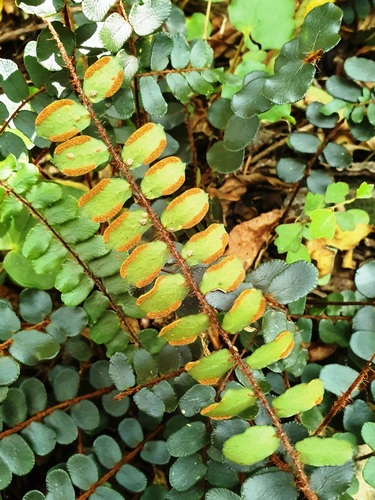
Sources differ on mature height, with the few available accounts placing it at about 10–50 cm, while mature spread is 10–50 cm. It is reported to take some years to reach mature size. The pinnate fronds have many small, nearly round to oblong, dark green, leathery, glossy pinnae; larger fronds can carry numerous pairs of pinnae, and the stalk or rachis is brown to dark reddish brown, sometimes with scales. It has a tufted rhizome, does not flower or produce fruit, and reproduces by spores.
Light
Part sun, filtered light or bright indirect light is suitable; some sources also list full sun as acceptable, but hot direct midday sun should be avoided.
Watering
Sources differ on watering: well-drained medium may be allowed to become somewhat dry at the surface or overall before watering and does not require the continuously high moisture typical of many ferns, while some horticultural sources recommend keeping it moist but well drained. The moisture target is to keep slightly dry.
Humidity and airflow
It prefers low humidity and has a low humidity need. It is generally reported to need good airflow.
Temperature and dormancy
A single source reports a minimum temperature of about -3.9 °C, so sources for this figure are few. Sources differ on its hardiness-zone classification. It is generally reported to tolerate brief light frost, while overall it is considered tender.
Growing medium and mounting
Use an acidic, loose, well-drained medium; loam, sandy soil, or humus-rich, peaty potting medium can be suitable.
Feeding
Water-soluble or slow-release fertilizer is reported to be suitable during the warmer growing seasons.
Propagation
It can be propagated by spores or division; another source also lists root and stem cuttings. Mature spores can be sown under suitable cool conditions. Division can be used for propagation, with one source specifically describing division of the rhizome.
Common problems
No major pests are recorded, and RHS also describes it as generally pest-free. No major diseases are recorded, and RHS also describes it as generally disease-free. Poor drainage or excessively wet conditions conflict with most cultivation recommendations, and prolonged conditions below freezing can also be harmful. Avoid prolonged freezing and strong winds; protect the crown in frosty areas and avoid strong direct sun during hot midday conditions.
Identification
Its most distinctive feature is the rows of round, dark green, leathery, button-like pinnae; the plant is compact and its fronds are glossy.
Photos



Sources
- Wikipedia (en): Pellaea rotundifolia — CC BY-SA 4.0 · link
- Wikipedia (es): Pellaea rotundifolia — CC BY-SA 4.0 · link
- NC State Plant Toolbox: Pellaea rotundifolia — copyright (facts only) · link
- RHS Plants: Pellaea rotundifolia — © RHS, facts only · link
- 臺北典藏植物園 植物資料庫: Pellaea rotundifolia — © 臺北典藏植物園, facts only · link
- Top Tropicals catalog: Pellaea rotundifolia — © Top Tropicals LLC (facts only) · link