
watermelon pepper (Peperomia argyreia)
Peperomia argyreia is an evergreen perennial herb with a compact, clumping to bushy habit.
Overview
Peperomia argyreia is an evergreen perennial herb with a compact, clumping to bushy habit.
Origin and habitat
Peperomia argyreia is native to South America, with Brazil and Bolivia consistently identified as native areas, while sources differ on whether Ecuador, Venezuela, and Argentina are also included. It is reported to occur in a tropical climate.
Characteristics
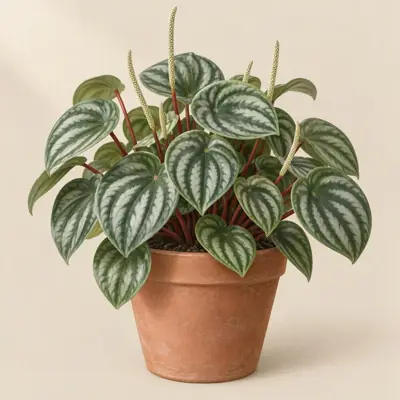
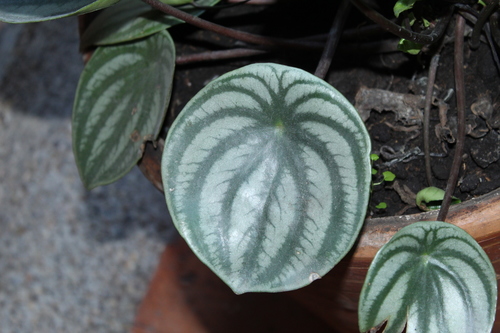
Sources differ on mature height, placing it at about 20–30 cm, while a single source reports a mature spread of about 20–30 cm. The green, ovate to nearly round, slightly asymmetrical leaves are somewhat fleshy to leathery, with prominent curved silver bands resembling watermelon rind, red petioles, and sometimes peltate attachment. The very small flowers range from green to greenish white or creamy white and are densely borne in spikes; sources differ in their descriptions of the flower spikes. A single source reports flowering in summer.
Light
Provide bright, indirect light to partial shade and avoid strong direct sunlight; RHS recommends more light in winter.
Watering
Water moderately during active growth in a well-drained medium, allowing the surface to feel dry before watering again; avoid prolonged wetness and reduce watering in winter.
Temperature and dormancy
Sources differ on the lower temperature limit, with limited evidence placing it at about 10 °C; a single source reports an upper limit of about 35 °C.
Growing medium and mounting
Use a well-drained medium that remains moderately moist; sources mention humus-rich material, gravel or coarse sand with peat, as well as loam or peat-free potting medium, with an acidic to neutral pH.
Feeding
A single source reports low fertilizer needs and recommends applying liquid fertilizer monthly during active growth from spring through summer while avoiding excessive feeding.
Propagation
Propagation can be by leafy stem cuttings, leaf cuttings with the petiole attached, leaf-bud cuttings, separated offsets, or seed; cuttings placed in moist medium can root within several weeks.
Common problems
Spider mites, mealybugs, scale insects, and aphids may occur, while slugs and snails may feed on the petioles; RHS reports that pest problems are generally uncommon. Overwatering can quickly cause root rot, although RHS reports that disease problems are generally uncommon. Overwatering can cause root rot, insufficient water can cause wilting, and strong direct sunlight can cause scorching and dehydration; overly dry conditions may increase spider-mite problems and be accompanied by distorted or yellowing leaves. It does not tolerate cold drafts or prolonged low temperatures, which can slow or stop growth, while strong direct sunlight can scorch the leaves.
Identification
Peperomia argyreia is distinguished by silver, watermelon-rind-like stripes on nearly round to ovate leaves, red petioles and stems, and the comparatively unusual peltate leaf attachment.
Photos


Sources
- Wikipedia (en): Peperomia argyreia — CC BY-SA 4.0 · link
- Wikipedia (fr): Peperomia argyreia — CC BY-SA 4.0 · link
- Wikipedia (es): Peperomia argyreia — CC BY-SA 4.0 · link
- GBIF descriptions: Lista de especies de plantas exóticas y trasplantadas de Colombia; Catálogo de Plantas y Líquenes de — per dataset · link
- NC State Plant Toolbox: Peperomia argyreia — copyright (facts only) · link
- RHS Plants: Peperomia argyreia — © RHS, facts only · link