
Emerald-Ripple Peperomia (Peperomia caperata)
Peperomia caperata is an evergreen perennial herb, typically forming clumps or a mounded to upright, bushy habit, while the 'Emerald Ripple' cultivar is described as having a trailing habit.
Overview
Peperomia caperata is an evergreen perennial herb, typically forming clumps or a mounded to upright, bushy habit, while the 'Emerald Ripple' cultivar is described as having a trailing habit.
Origin and habitat
Peperomia caperata is native to Brazil, with some sources more broadly describing its native range as South America or Central and South America. In its natural environment it can grow beneath trees and can also occur as an epiphyte in South American jungle habitats. It is a tropical plant and is commonly grown indoors in temperate regions.
Characteristics
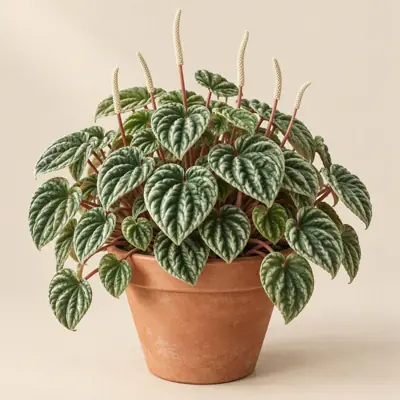
Sources differ on mature size, but report a height of about 20 cm and a spread of about 20 cm. The leaves are thick or fleshy and heart-shaped, with strongly wrinkled, deeply grooved or rippled surfaces; the species has dark green leaves and petioles that may be pink to red, while 'Emerald Ripple' has green and creamy-white leaves with a rippled pattern. The very small white, creamy-white to greenish-white flowers are densely borne on slender, upright, tail-like or club-like spikes; 'Emerald Ripple' is also described as having small white flowers. Flowering is reported from spring through autumn, with some sources specifically noting summer flowering.
Light
Sources differ in their descriptions of light needs, but bright indirect light to filtered medium light is given as the main growing condition; the plant can tolerate low light briefly, may receive more light in winter, and strong direct light may fade the leaves and weaken the plant.
Watering
Water moderately to sparingly in a well-drained medium that can dry between waterings, with moderate watering in summer and less in winter; persistently wet conditions should be avoided because overwatering can cause root rot.
Temperature and dormancy
A source reports a minimum temperature of about 15 °C; sources are few.
Growing medium and mounting
Use a well-drained, porous medium; sources mention mixes containing humus, gravel and peat, as well as loam, sandy soil or general indoor plant potting medium, with acidic, neutral or alkaline soil conditions described.
Feeding
A source reports using a balanced liquid fertilizer from spring through summer.
Propagation
Peperomia caperata can be propagated from leaves, leaves with petioles, or stem-tip cuttings; spring and summer are suitable for leaf cuttings, and seeds can also be sown when mature.
Common problems
Sources differ on pest problems: mealybugs, spider mites and whiteflies may occur, while another account describes the plant as generally having few pest problems. Root rot, occasional leaf spot and gray mold may occur. The main cultivation problem is root rot from an overly wet medium; the plant also does not tolerate excessively dry conditions or strong drafts, and strong direct light may fade the leaves or weaken the plant. It is reported to be sensitive to low temperatures and generally unsuitable for ordinary outdoor cultivation under sufficiently cold conditions; in most temperate regions it needs to overwinter indoors.
Identification
Peperomia caperata can be recognized by its heart-shaped leaves with very prominent deep grooves and wrinkles and by its slender flower spikes; 'Emerald Ripple' has green and creamy-white rippled leaves and a trailing habit.
Photos


Sources
- Wikipedia (en): Peperomia caperata — CC BY-SA 4.0 · link
- 維基百科:皱叶椒草 — CC BY-SA 4.0 · link
- Wikipedia (fr): Peperomia caperata — CC BY-SA 4.0 · link
- Wikipedia (es): Peperomia caperata — CC BY-SA 4.0 · link
- NC State Plant Toolbox: Peperomia caperata — copyright (facts only) · link
- TaiCOL 臺灣物種名錄: Peperomia caperata — CC BY 4.0 · link
- RHS Plants: Peperomia caperata — © RHS, facts only · link