
baby rubberplant (Peperomia obtusifolia)
Peperomia obtusifolia is a perennial, evergreen herb with a clumping to shrubby habit, although sources describe the habit differently.
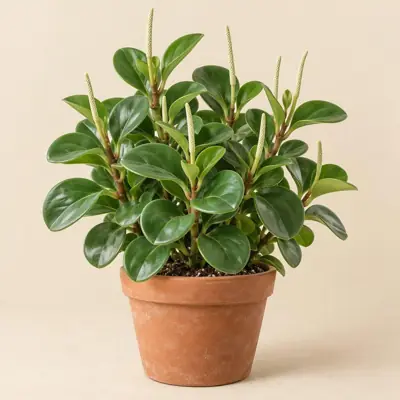
Overview
Peperomia obtusifolia is a perennial, evergreen herb with a clumping to shrubby habit, although sources describe the habit differently.
Origin and habitat
Peperomia obtusifolia is native to tropical America, with accounts differing on the more specific extent of its distribution, which includes Florida, Mexico, Central America, the West Indies, and South America south to Peru, Bolivia, and Brazil. In Colombia, it is reported from a broad elevational span and from the Amazon, Andes, Guiana and Macarena highlands, Sierra Nevada de Santa Marta, Cauca Valley, and Magdalena Valley biogeographic regions. It occurs in tropical, frost-free environments and does not tolerate frost or low temperatures.
Characteristics
Sources differ on mature height, placing it at about 20–50 cm, while mature spread is 10–50 cm. The leaves are thick, leathery to fleshy, and glossy or waxy, commonly cup-shaped and obovate to broadly elliptic with blunt, rounded tips; some cultivars have variegated leaves. The very small white to greenish-white or creamy-white flowers are densely borne on slender spikes. Flowering is reported to be variable, occurring mainly in late summer.
Light
It suits bright, indirect light to partial shade, and non-variegated forms can tolerate periods of low light; strong or direct sunlight should be avoided because it can cause leaf discoloration or scorching.
Watering
Watering should not be excessive or too frequent; use a well-drained medium and water after the surface has dried slightly, while avoiding both prolonged wetness and extreme drying. Overwatering can cause yellow leaves, rotting of stems and leaves, or root rot. A single source reports a summer watering interval of about 7–10 days, so sources are few.
Humidity and airflow
It prefers low humidity and needs little air movement.
Temperature and dormancy
A single source places the minimum temperature at around 15 °C, so sources are few. Sources differ on its hardiness-zone classification. It is frost tender; keep above freezing.
Growing medium and mounting
Use a well-drained growing medium; RHS lists chalky, loamy, or sandy soils and indicates that acidic, neutral, or alkaline conditions are suitable.
Propagation
It can be propagated by seed, softwood cuttings, leaf cuttings, or bud cuttings; stem cuttings need leaves, and a Spanish-language source also indicates that a single leaf can be used for propagation.
Common problems
Pest problems are generally not serious, but aphids, mealybugs, spider mites, and whiteflies may occur. Serious disease problems are generally absent, although overwatering can lead to root rot, yellow leaves, and rotting of stems and leaves. Strong or direct light can cause abnormal leaf color or leaf scorch. It is sensitive to frost, low temperatures, strong wind, and exposed windy locations, and is suited to sheltered, frost-free conditions.
Identification
It is reported to be identifiable by thick, cup-shaped, glossy, obovate leaves, conspicuously branching stems, petioles and stems often tinged pink to red, and slender creamy-white flower spikes.
Photos


Sources
- GBIF Backbone: Peperomia obtusifolia (L.) A.Dietr. — CC BY 4.0 · link
- Wikipedia (en): Peperomia obtusifolia — CC BY-SA 4.0 · link
- 維基百科:圆叶椒草 — CC BY-SA 4.0 · link
- Wikipedia (fr): Peperomia obtusifolia — CC BY-SA 4.0 · link
- Wikipedia (es): Peperomia obtusifolia — CC BY-SA 4.0 · link
- GBIF descriptions: Lista de chequeo de las plantas nativas de la cuenca del río Claro (Antioquia, Colombia) con reporte — per dataset · link
- NC State Plant Toolbox: Peperomia obtusifolia — copyright (facts only) · link
- Wikipedia (it): Peperomia obtusifolia — CC BY-SA 4.0 · link
- TaiCOL 臺灣物種名錄: Peperomia obtusifolia — CC BY 4.0 · link
- RHS Plants: Peperomia obtusifolia — © RHS, facts only · link
- USDA PLANTS Database: Peperomia obtusifolia — Public domain (US Government work) · link
- Top Tropicals catalog: Peperomia obtusifolia — © Top Tropicals LLC (facts only) · link