
baby rubberplant (Peperomia obtusifolia)
Peperomia obtusifolia is an evergreen perennial herb with an upright to clumping habit.
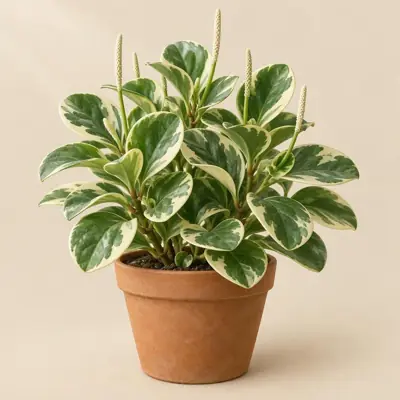
Overview
Peperomia obtusifolia is an evergreen perennial herb with an upright to clumping habit.
Origin and habitat
Sources differ on details of its native range, but describe it as native to tropical America, including Mexico, the Caribbean or West Indies, and South America. Colombian records are reported to place it across the Amazon, Andes, Guiana and Macarena highlands, Sierra Nevada, and river-valley biogeographic regions. It is associated with tropical, frost-free conditions and is commonly grown as an indoor or greenhouse plant in temperate regions.
Characteristics
Sources differ on mature height, with the limited evidence suggesting about 10–50 cm. A single source reports a mature spread of about 10–50 cm, so sources are few. The glossy, cupped leaves are obovate to broadly elliptic and leathery or fleshy; 'Variegata' has green leaves with creamy-white markings. Tiny white to creamy-white flowers are densely arranged in slender spikes, and flowering is reported to be irregular and mainly in late summer.
Light
Provide bright indirect light to partial shade; it tolerates lower light, but variegated forms need better light to maintain leaf color, while excessively strong or direct sunlight can cause fading or leaf scorch.
Watering
Water moderately without frequent heavy watering, using a well-drained medium and avoiding both prolonged excessive moisture and extreme dryness.
Temperature and dormancy
A single source suggests a minimum temperature of about 15 °C, so sources are few. It is generally classified as RHS H1B.
Growing medium and mounting
Use a well-drained growing medium; RHS lists loam, sandy, and chalky soils, with acidic, neutral, or alkaline conditions and moisture ranging from moist but well-drained to generally well-drained.
Propagation
Peperomia obtusifolia can be propagated by seed, softwood cuttings, leaf cuttings, or bud cuttings; leafy stem cuttings or single leaves can also be used.
Common problems
Pest and disease problems are generally limited, although aphids, mealybugs, spider mites, and whiteflies may occur, and overwatering is a principal risk for root rot. Overwatering can cause yellow leaves, stem or leaf rot, or root rot, while excessively strong direct light can fade or scorch the leaves. It is sensitive to low temperatures, frost, strong winds, and strong drafts; colder conditions call for moving it indoors or into a protected environment.
Identification
It is generally identified by glossy, cupped, obovate leaves, conspicuously branching stems, and slender creamy-white flower spikes; 'Variegata' is distinguished by creamy-white markings on green leaves.
Photos


Sources
- Wikipedia (en): Peperomia obtusifolia — CC BY-SA 4.0 · link
- 維基百科:圆叶椒草 — CC BY-SA 4.0 · link
- Wikipedia (fr): Peperomia obtusifolia — CC BY-SA 4.0 · link
- Wikipedia (es): Peperomia obtusifolia — CC BY-SA 4.0 · link
- GBIF descriptions: Lista de chequeo de las plantas nativas de la cuenca del río Claro (Antioquia, Colombia) con reporte — per dataset · link
- NC State Plant Toolbox: Peperomia obtusifolia — copyright (facts only) · link
- TaiCOL 臺灣物種名錄: Peperomia obtusifolia — CC BY 4.0 · link
- RHS Plants: Peperomia obtusifolia — © RHS, facts only · link
- USDA PLANTS Database: Peperomia obtusifolia — Public domain (US Government work) · link