
yerba linda (Peperomia rotundifolia)
Peperomia rotundifolia is a perennial, semi-succulent herb with creeping, trailing, or hanging growth, and it can also grow as an epiphyte on other plants.
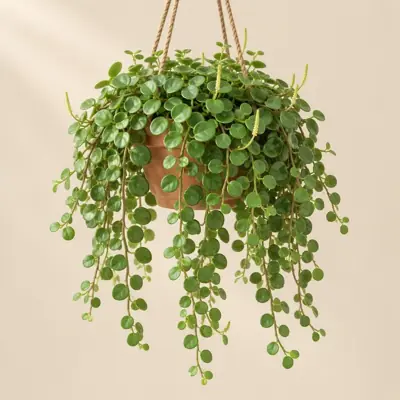
Overview
Peperomia rotundifolia is a perennial, semi-succulent herb with creeping, trailing, or hanging growth, and it can also grow as an epiphyte on other plants.
Origin and habitat
Sources differ on its native range: they support a distribution across tropical to subtropical parts of the Americas, including Mexico, Central America, the Caribbean, and South America, while some also regard the southeastern United States as native. It occurs in moist tropical forests, growing as an epiphyte on trees as well as in rock crevices, decaying wood, and on the forest floor, with shaded to partly shaded conditions. It is mainly found in warm, humid tropical forest environments.
Characteristics
A single source reports a mature height of about 0–10 cm and a mature spread of about 10–50 cm, so sources are few for these measurements. The leaves are small, round to button-like, thick, fleshy, and succulent, usually bright green, with some descriptions noting paler green veins. The small flowers form slender, pale yellow to greenish-white spikes.
Light
Sources differ in their descriptions of light needs; for container growing, bright indirect light to partial shade is described as suitable, while strong direct sunlight should be avoided.
Watering
Sources differ in their watering descriptions; during active growth, the medium should be kept moderately moist but well drained, avoiding waterlogging and overwatering, with watering reduced in winter.
Temperature and dormancy
A single source reports a minimum temperature of about 16 °C and an ideal range of about 17–25 °C, so sources are few for these temperatures. It is generally reported in the stated USDA hardiness classification.
Growing medium and mounting
Use a light, loose, porous, well-drained medium that remains moderately moist without becoming waterlogged; it can adapt to loamy or sandy media and to acidic, neutral, or alkaline pH.
Feeding
It is reported to receive balanced liquid fertilizer monthly from spring through summer.
Propagation
Sources differ on propagation details; Peperomia rotundifolia can be propagated from stem cuttings, leaf cuttings, or seed, and leafy stem cuttings placed in moist medium can form roots after several weeks.
Common problems
Sources differ on pest reports, with mealybugs described as a possible pest. Sources differ on disease reports, which include root rot, rotting cuttings, and ringspot problems. Overwatering can cause yellowing leaves, wilting, scar-like raised areas on leaves, or root rot, while low humidity or an overly dry medium may cause leaves to curl. It is sensitive to cold drafts and prefers warm, humid conditions; indoor plants should be kept away from cold drafts.
Identification
Peperomia rotundifolia has slender creeping or hanging stems densely set with small, round, fleshy leaves, and it can creep along the ground, tree branches, or other surfaces.
Photos


Sources
- Wikipedia (en): Peperomia rotundifolia — CC BY-SA 4.0 · link
- Wikipedia (es): Peperomia rotundifolia — CC BY-SA 4.0 · link
- GBIF descriptions: Lista de chequeo de las plantas nativas de la cuenca del río Claro (Antioquia, Colombia) con reporte — per dataset · link
- NC State Plant Toolbox: Peperomia rotundifolia — copyright (facts only) · link
- RHS Plants: Peperomia rotundifolia — © RHS, facts only · link
- USDA PLANTS Database: Peperomia rotundifolia — Public domain (US Government work) · link