
parsley (Petroselinum crispum)
Petroselinum crispum is an aromatic herb with an upright to clumping habit. Sources differ on its life cycle: it is described mainly as biennial, often grown as an annual in cultivation, and in some accounts as a short-lived perennial.
Overview
Petroselinum crispum is an aromatic herb with an upright to clumping habit. Sources differ on its life cycle: it is described mainly as biennial, often grown as an annual in cultivation, and in some accounts as a short-lived perennial.
Origin and habitat
Sources differ in describing its native range around the Mediterranean, with more specific accounts centered on the Balkan Peninsula, Greece, Algeria, and Morocco, while others refer more broadly to the Mediterranean region. It occurs in grassy waste ground, on walls, and in rocky environments, especially limestone and coastal areas, and is also common in farms, gardens, and other disturbed or cultivated settings. It grows best in temperate, cooler climates but can also be cultivated in subtropical and tropical climates; high temperatures suppress growth.
Characteristics
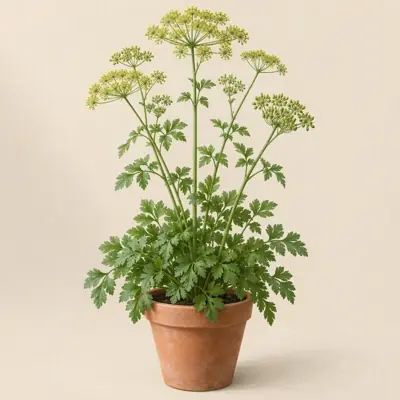
Sources differ, placing mature height at about 30–90 cm; the limited source evidence reports a mature spread of about 10–50 cm. The aromatic leaves are green to dark green and are usually divided into compound forms; cultivated forms may have flat or curly leaves, with basal leaves becoming relatively long. Small yellow-green to pale green flowers are borne in compound umbels, usually flowering in summer of the second year and sometimes continuing into autumn. The fruit is reported to be ovoid to flattened-elliptic or broadly ovoid and is commonly referred to as a seed.
Light
Petroselinum crispum grows in full sun to partial sun, and moderate shade can support growth in hot regions.
Watering
Keep the soil consistently moist but well drained and avoid allowing it to dry out; indoor cultivation also requires ample watering.
Temperature and dormancy
Limited source evidence places the minimum at about -5 °C, with an ideal range of about 11–20 °C and a maximum of about 28 °C. It is reported to have an RHS hardiness classification.
Growing medium and mounting
Grow it in fertile, moist but well-drained soil; it can grow in chalk, clay, loam, or sand and in acidic, neutral, or alkaline conditions.
Feeding
It is reported that compost and slow-release fertilizer can be applied before planting, with additional feeding during growth according to the plant's condition.
Propagation
Propagate by seed, either by successive direct sowing from late spring through summer or by raising seedlings before transplanting. Germination can take a relatively long time, and disturbance of the taproot should be minimized during transplanting.
Common problems
Carrot fly and leaf-feeding butterfly larvae may cause damage, and Japanese sources specifically record citrus swallowtail larvae as capable of rapidly feeding on the leaves. Germination can be slow, while dry or hot conditions can cause poor growth or wilting; after flowering, leaf flavor and harvest quality decline. Sources differ in their descriptions of weather sensitivity, but report that the plant does not tolerate dryness, that high temperatures suppress growth, and that young growing parts can be seriously damaged around freezing conditions.
Identification
Petroselinum crispum has finely divided, characteristically aromatic bright-green to dark-green leaves, with conspicuously curly leaves common among cultivated forms; in its second year it produces flowering stems bearing umbels.
Photos


Sources
- Wikipedia (en): Parsley — CC BY-SA 4.0 · link
- 維基百科:歐芹 — CC BY-SA 4.0 · link
- Wikipedia (ja): パセリ — CC BY-SA 4.0 · link
- Wikipedia (de): Petersilie — CC BY-SA 4.0 · link
- Wikipedia (fr): Persil — CC BY-SA 4.0 · link
- Wikipedia (es): Petroselinum crispum — CC BY-SA 4.0 · link
- GBIF descriptions: Database of Vascular Plants of Canada (VASCAN); Checklist of introduced taxa in Romania; Catálogo de — per dataset · link
- NC State Plant Toolbox: Petroselinum crispum — copyright (facts only) · link
- Useful Tropical/Temperate Plants: Petroselinum crispum — CC BY-NC-SA 3.0 (facts only) · link
- RHS Plants: Petroselinum crispum — © RHS, facts only · link
- USDA PLANTS Database: Petroselinum crispum — Public domain (US Government work) · link