
Petunia (Petunia × atkinsiana)
Petunia atkinsiana is a perennial herb with softly hairy, thick stems that have a creeping, semi-trailing habit; some ground-covering cultivars remain low and spread laterally.
Overview
Petunia atkinsiana is a perennial herb with softly hairy, thick stems that have a creeping, semi-trailing habit; some ground-covering cultivars remain low and spread laterally.
Origin and habitat
Sources differ on its horticultural hybrid origin; its parentage involves plants originating from South America, and historical accounts report that this hybrid group appeared at a nursery at Painshill in England. It tolerates relatively hot and harsh conditions and is suited to abundant sunlight, relatively low humidity, and good airflow.
Characteristics
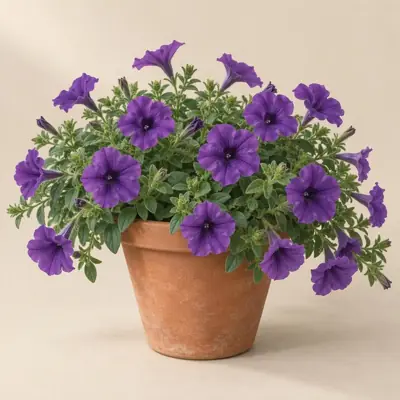
A single source reports a mature height of about 10–56 cm and a mature spread of about 91–122 cm; sources are few for these measurements. The leaves are ovate, and the plant is reported to be softly hairy. Sources differ in their descriptions of the flowers: they are trumpet-shaped and usually solitary, with yellow, purple, red, white, pink, or deep pink forms, while cultivars may also have edged, star-shaped, bicolored, or double flowers; flower size varies greatly among cultivars. Flowering is reported from winter through spring and may continue into late spring; after flowering, the plant readily sets seed in seed pods.
Light
Abundant sunlight is needed, although sources differ on the recommended minimum duration of direct sunlight each day.
Watering
Keep the soil moist; watering may need to be more frequent in dry areas, and direct wetting of the flowers should be avoided when watering.
Growing medium and mounting
It is reported to suit soil that is kept moist.
Feeding
Fertilizing regularly is reported to encourage rapid growth, and ground-covering forms also need adequate nutrients to spread fully.
Propagation
It can be propagated from seed or cuttings; offspring from seed collected from horticultural hybrids may show deterioration of traits, so first-generation hybrid seed is recommended to retain better horticultural characteristics.
Common problems
Disease is reported to be more likely under hot, humid conditions with poor airflow, and high humidity with poor airflow may increase disease problems. Offspring propagated from saved seed are reported to potentially become elongated and develop progressively smaller flowers. Some types are sensitive to heavy rain, particularly large-flowered forms; weather tolerance varies markedly among strains, and some small-flowered forms tolerate harsh weather better.
Identification
Typical distinguishing features include soft hair on the plant, thick creeping and semi-trailing stems, and trumpet-shaped flowers with diverse colors and forms; it is a horticultural hybrid group formed from Petunia parents.
Sources
- Wikipedia (en): Petunia × atkinsiana — CC BY-SA 4.0 · link
- Wikipedia (en): Petunia atkinsiana — CC BY-SA 4.0 · link
- GBIF descriptions: Checklist of introduced taxa in Romania; Especies introducidas, exóticas, trasplantadas, invasoras y — per dataset · link
- 農業知識入口網 植物圖鑑: Petunia atkinsiana — © MOA, facts only · link