
Moth orchid (Phalaenopsis amabilis)
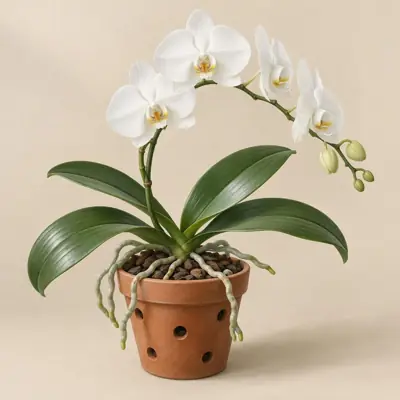
Phalaenopsis amabilis is a perennial, monopodial tropical orchid herb that is mainly epiphytic, with some plants growing on rocks, and it lacks pseudobulbs.
Overview
Phalaenopsis amabilis is a perennial, monopodial tropical orchid herb that is mainly epiphytic, with some plants growing on rocks, and it lacks pseudobulbs.
Origin and habitat
Sources differ on its native range, describing it across maritime Southeast Asia to New Guinea and northern Australia, including the Philippines, Malaysia and Indonesia, with different subspecies reported from Borneo, Sumatra, Java, the Moluccas, Sulawesi, New Guinea and Queensland. It grows mainly as an epiphyte on trunks and branches in humid forests, often below the canopy away from strong direct light; some sources also record it on trees near rivers, swamps and streams, while a minority of plants grow on rocks. Its habitat has a tropical to warm, humid forest climate, usually with canopy shade.
Characteristics
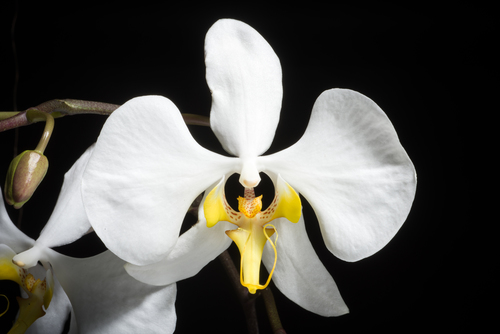
A single source reports a mature height of about 50–100 cm and a spread of about 10–50 cm, so sources are few for these dimensions. The leaves are thick and fleshy to leathery, green, and commonly elliptic, ovate or oblong, arranged along a short stem. Sources differ in their descriptions of the flowers: they are large and predominantly white with spreading floral segments, and have a three-lobed lip with yellow areas and red or reddish-brown markings; the long inflorescences are often arching or pendent, may branch and bear multiple flowers, while the long-lasting flowers are described as fragrant by some sources. Sources differ on flowering season, which varies with location and growing conditions; a single source also reports that pollinated flowers wither and form capsules whose color ranges from brown to green depending on plant origin.
Light
Sources differ somewhat on light guidance, describing bright, indirect light to partial shade, with strong direct sunlight avoided and some shading during summer; this corresponds to medium light. A specialist source reports about 10750–21500 for light intensity, but sources are few.
Watering
Water thoroughly, then wait until the growing medium is nearly dry or slightly dry before watering again; water needs are greater in summer and lower in winter. Avoid standing water in the pot and prolonged water retention in the crown to reduce the risk of rot.
Humidity and airflow
Phalaenopsis amabilis generally prefers high humidity; a specialist source reports about 50–80 %, but sources are few.
Temperature and dormancy
Phalaenopsis amabilis is intermediate to warm and frost tender; keep above freezing. A specialist source reports an upper temperature of about 35 °C, but sources are few.
Growing medium and mounting
Sources differ on the specific potting material but describe an airy, free-draining orchid medium such as bark, sphagnum moss or coconut-husk material, with bark also given as the media preference. The plant is epiphytic and is reported to have aerial roots with velamen.
Feeding
Fertilizer may be applied regularly during active growth; one recommendation uses slow-release fertilizer in spring followed by liquid fertilizer regularly through early autumn.
Propagation
Propagation can use side shoots or plantlets formed on flower spikes; separate and plant a plantlet after it has developed roots.
Common problems
Possible pests include aphids, scale insects, mealybugs, greenhouse red spider mites, thrips, false spider mites and slugs. Water retained in the crown can increase the risk of crown or new-leaf rot, while prolonged cold and wet growing medium can promote root rot; Botrytis is also recorded for Phalaenopsis. High temperatures without sufficient humidity and airflow can hinder growth, and sharp temperature fluctuations may cause bud drop. It has low cold tolerance and greater heat tolerance, prefers warmth, needs shade from intense sunlight, and requires correspondingly greater humidity and airflow under high temperatures.
Identification
A single source reports thick roots, fleshy leaves and large white flowers, with a three-lobed lip bearing a conspicuous yellow callus near the base and reddish markings; the middle lobe of the lip is cross-shaped in the typical subspecies.
Photos


Sources
- Wikipedia (en): Phalaenopsis amabilis — CC BY-SA 4.0 · link
- Wikipedia (de): Phalaenopsis amabilis — CC BY-SA 4.0 · link
- Wikipedia (fr): Phalaenopsis amabilis — CC BY-SA 4.0 · link
- Wikipedia (es): Phalaenopsis amabilis — CC BY-SA 4.0 · link
- Wikipedia (it): Phalaenopsis amabilis — CC BY-SA 4.0 · link
- Wikipedia (nl): Maanorchidee — CC BY-SA 4.0 · link
- RHS Plants: Phalaenopsis amabilis — © RHS, facts only · link
- NHK みんなの趣味の園芸 植物図鑑: Phalaenopsis amabilis — © NHK出版, facts only · link
- Internet Orchid Species Photo Encyclopedia: Phalaenopsis amabilis — © Jay Pfahl / IOSPE contributors, facts only · link
- AOS culture sheet: Phalaenopsis (genus-level) — © American Orchid Society, facts only · link
- NC State Plant Toolbox: Phalaenopsis (genus-level) — copyright (facts only) · link