
Phalaenopsis schilleriana (Phalaenopsis schilleriana)
Phalaenopsis schilleriana is a tropical evergreen perennial epiphytic herbaceous orchid that can be grown as an indoor potted or greenhouse plant, with inflorescences that may arch or hang downward.
Overview
Phalaenopsis schilleriana is a tropical evergreen perennial epiphytic herbaceous orchid that can be grown as an indoor potted or greenhouse plant, with inflorescences that may arch or hang downward.
Origin and habitat
Phalaenopsis schilleriana is native to the Philippines, including Luzon and nearby smaller islands. It is reported to grow epiphytically on rainforest trees, including higher in the trees, from sea level into higher elevations. Its habitat is tropical, relatively warm, and humid.
Characteristics
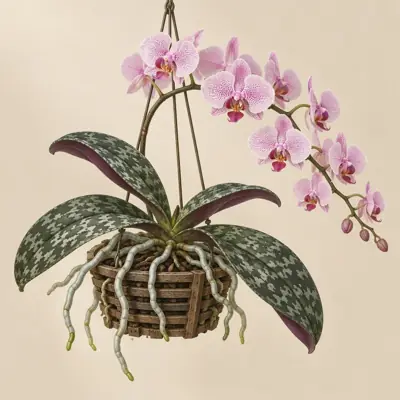
Sources differ on mature height, placing it at about 15.24–30.48 cm, while a single source reports a mature spread of about 30.48–60.96 cm. The thick, fleshy leaves are linear-oblong to elliptic, dark green with gray-green to silver transverse mottling, and often dark purple beneath. The large, fragrant flowers are pale pink to pink, with a three-lobed lip ranging from white to peach-purple and sometimes marked with yellow and red spots; long, branching inflorescences can carry many flowers. It is reported to flower from midwinter through late spring, mainly in spring, with an individual flowering period lasting several weeks.
Light
Phalaenopsis schilleriana favors bright filtered or indirect light, such as partial shade or light near an east- or west-facing window, while strong direct midday sun should be avoided; it is also described as shade-preferring and suited to low light.
Watering
Water thoroughly and then wait until the medium is nearly dry before watering again; avoid prolonged waterlogging, complete drying, and water remaining for long periods in the center of the crown. The plant should be kept slightly dry. Evidence is limited to a specialist source, which reports a summer watering interval of about 2 days and a winter interval of about 10 days.
Humidity and airflow
It generally prefers high humidity. Evidence is limited to a specialist source reporting a preferred humidity range of about 50–80 %.
Temperature and dormancy
Phalaenopsis schilleriana is warm-growing. It is generally frost tender and should be kept above freezing.
Growing medium and mounting
Use a well-drained, well-aerated orchid medium such as an open bark mix, long-fiber sphagnum, or coconut-husk medium; the plant is also commonly grown attached to cork or bark substrates. It is epiphytic, has aerial roots with velamen, and has a preference for bark.
Feeding
Apply orchid fertilizer regularly during growth; Phalaenopsis may receive dilute fertilizer during warm growth, with a higher-nitrogen formula for bark media and a balanced fertilizer for other media.
Propagation
Seed propagation requires a controlled laboratory environment; mature plants may produce side shoots or keikis that can be separated and planted after new roots develop.
Common problems
Phalaenopsis schilleriana may develop gray mold, while standing water in the crown may lead to bacterial rot or crown rot. Persistently wet medium may cause root rot, water in the crown increases the risk of rot, and severe temperature fluctuations while buds are present may cause bud drop. It prefers warmth and should be protected from strong direct sunlight; hot conditions require higher humidity and good air circulation, while cooler autumn nights can help induce flower-spike formation.
Identification
Phalaenopsis schilleriana has thick roots, fleshy dark green leaves mottled silver-gray, often with purple on their undersides, and large pink flowers; mature plants can form long, branching inflorescences that arch or hang downward and carry many flowers.
Photos


Sources
- Wikipedia (en): Phalaenopsis schilleriana — CC BY-SA 4.0 · link
- Wikipedia (ja): ファレノプシス・シレリアナ — CC BY-SA 4.0 · link
- Wikipedia (fr): Phalaenopsis schilleriana — CC BY-SA 4.0 · link
- Wikipedia (es): Phalaenopsis schilleriana — CC BY-SA 4.0 · link
- NC State Plant Toolbox: Phalaenopsis schilleriana — copyright (facts only) · link
- RHS Plants: Phalaenopsis schilleriana — © RHS, facts only · link
- AOS culture sheet: Phalaenopsis (genus-level) — © American Orchid Society, facts only · link
- NHK みんなの趣味の園芸 植物図鑑: Phalaenopsis (genus-level) — © NHK出版, facts only · link
- IOSPE PHOTOS (www.orchidspecies.com) — facts only (§12) · link