
thaumatophyllum (Philodendron bipinnatifidum)
Philodendron bipinnatifidum is a perennial evergreen with a shrub-like habit, initially upright and becoming more creeping or leaning with age; its stem may become semi-woody, and with support it can attach by aerial roots.
Watch: Monstera vs Philodendron vs Alocasia vs Anthurium
Overview
Philodendron bipinnatifidum is a perennial evergreen with a shrub-like habit, initially upright and becoming more creeping or leaning with age; its stem may become semi-woody, and with support it can attach by aerial roots.
Origin and habitat
Sources differ on its native range in South America: they commonly include Brazil, Argentina, and Paraguay, while some also include Bolivia, and botanical-garden data cited by GBIF describe the range more broadly as central South America. In its native habitat it can grow on trees and climb by aerial roots; sources also characterize its habitat as tropical to subtropical South America. It is a tropical to subtropical plant and can also be cultivated in warm-temperate landscapes.
Characteristics
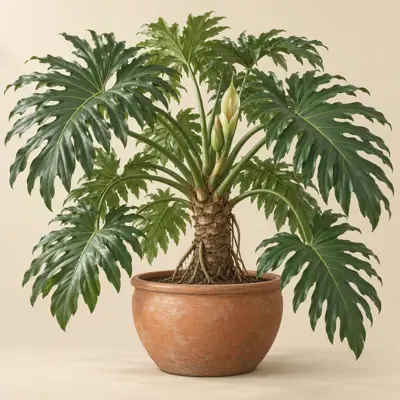
Sources differ and are few, but mature plants are reported to reach about 250–400 cm in height and about 250–400 cm in spread. The large, dark green to glossy leaves have long petioles and deeply pinnately divided blades with often wavy lobes; as plants mature, the lobes generally become more numerous and deeper. The inflorescence is a typical aroid spadix bearing small petal-less flowers and surrounded by a spathe; sources differ in describing the spathe as white to creamy yellow, purple, creamy white, or purplish red, and the spadix has female and male flowers with a central zone of sterile male flowers.
Light
Bright indirect light to partial sun is presented as the more reliable condition, and the plant can adapt to lower light; sources differ, with some reporting growth in full sun while also noting that strong direct sunlight can scorch the leaves. It tolerates some direct sun.
Watering
During growth, keep the soil moist but well drained, avoid prolonged waterlogging, and water again when the surface begins to dry; the plant does not tolerate drought or salt accumulation.
Humidity and airflow
It is generally reported to prefer high humidity and to need little air movement.
Temperature and dormancy
Its reported hardiness classifications include USDA and RHS categories, without numerical values stated here. With limited source evidence, the reported minimum temperature is about 15.6 °C. It is generally reported to be frost tender; keep above freezing.
Growing medium and mounting
It grows well in organic- or humus-rich soil that retains moisture while draining well, including loam or humus-rich sandy loam; it can adapt from acidic through neutral to alkaline conditions but does not tolerate salt accumulation in the soil. It has aerial and soil roots.
Feeding
During growth, a balanced liquid fertilizer may be applied monthly; another source indicates that overall fertilizer needs are low but that occasional fertilizer with a higher magnesium content can be beneficial.
Propagation
Propagation can be by seed, cuttings, division, or layering; stem-tip cuttings and cuttings with a leaf bud are also recorded.
Common problems
Possible pests include aphids, mealybugs, scale insects, thrips, and spider mites. Excessively wet growing medium may lead to root rot, although the RHS broadly describes the plant as usually having few disease problems. Insufficient light and overwatering can result in smaller leaves with fewer or no divisions, while salt accumulation in the soil can impair growth. The plant is sensitive to frost and freezing, and its large leaves can be damaged by strong winds; sheltered sites are preferable, while severe frost in cold regions may kill all above-ground growth, with regrowth from the roots possible when conditions are suitable.
Identification
Key identifying features are large, deeply divided leaves, stout stems with conspicuous leaf scars, and strong aerial roots emerging from the stem; leaf divisions generally become more pronounced as the plant matures.
Photos


Sources
- GBIF Backbone: Philodendron bipinnatifidum Schott ex Kunth, 1841 — CC BY 4.0 · link
- Wikipedia (en): Philodendron bipinnatifidum — CC BY-SA 4.0 · link
- NC State Plant Toolbox: Philodendron bipinnatifidum — copyright (facts only) · link
- Useful Tropical/Temperate Plants: Philodendron bipinnatifidum — CC BY-NC-SA 3.0 (facts only) · link
- RHS Plants: Philodendron bipinnatifidum — © RHS, facts only · link
- 臺北典藏植物園 植物資料庫: Philodendron bipinnatifidum — © 臺北典藏植物園, facts only · link
- NHK みんなの趣味の園芸 植物図鑑: Philodendron (genus-level) — © NHK出版, facts only · link
- Top Tropicals catalog: Philodendron bipinnatifidum — © Top Tropicals LLC (facts only) · link
- Thaumatophyllum bipinnatifidum | Foliage Factory (www.foliage-factory.com) — facts only (§12) · link