
Philodendron (Philodendron erubescens)
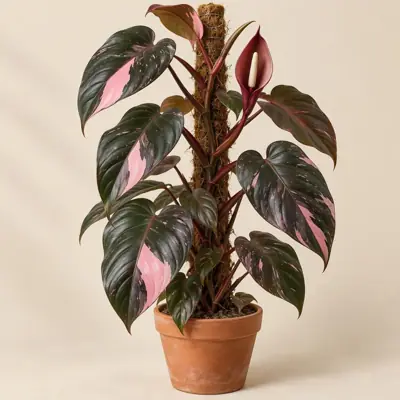
Philodendron erubescens is an evergreen, perennial herb with a climbing growth habit; 'Pink Princess' has an upright, vining habit and can climb a support.
Watch: Monstera vs Philodendron vs Alocasia vs Anthurium
Overview
Philodendron erubescens is an evergreen, perennial herb with a climbing growth habit; 'Pink Princess' has an upright, vining habit and can climb a support.
Origin and habitat
Sources differ on its native range, with Colombia recorded. It occurs in tropical humid biomes and rainforest environments, with Colombian records also placing it on the Caribbean plain at an elevated site. It is associated with tropical, warm conditions, prefers higher humidity, and does not tolerate low temperatures or frost.
Characteristics
Sources differ, and are few, on mature size, reporting a height of about 250–400 cm and a spread of about 50–100 cm. Sources describe the foliage differently: 'Pink Princess' has heart-shaped, dark purple-green leaves with pink variegation, while the species generally has glossy dark-green upper leaf surfaces and reddish-purple, purple, or copper-colored undersides, with leaves capable of becoming large. Sources differ on the floral description: 'Pink Princess' can produce purplish-red spathes with white spadices, and the species can produce relatively large spathes. Flowering occurs from summer into autumn, although indoor-grown plants rarely flower.
Light
Philodendron erubescens favors bright filtered or indirect light to partial shade and can tolerate lower light, but strong direct sunlight should be avoided. Its light tolerance is characterized as bright indirect light.
Watering
During active growth, keep the growing medium moist but well drained and water after the surface begins to dry; reduce watering in winter or when growth slows, and avoid overwatering.
Humidity and airflow
Philodendron erubescens prefers high humidity.
Temperature and dormancy
A single source reports a lower temperature of about 15 °C; sources are few. Sources differ in their hardiness classifications. It is generally frost tender; keep above freezing.
Growing medium and mounting
Use an organic-rich medium that retains moisture while draining well; a loam-based, peat-free potting medium is specified by RHS, with acidic, neutral, or alkaline pH accepted, while general Philodendron information from NHK also recommends a humus-rich, well-drained medium. An airy mix is suitable.
Feeding
Sources differ on feeding guidance, with a limited account recommending balanced liquid fertilizer regularly during the growing period.
Propagation
The species can be propagated by seed or layering in spring; vining Philodendron can also be propagated from stem cuttings with multiple nodes during the stated propagation period, and general information reports that rooting can occur within a relatively short period under appropriate management.
Common problems
Potential pests include spider mites, mealybugs, aphids, scale insects, and greenhouse red spider mites; general Philodendron information also records slugs. Overwatering can lead to root rot, and leaf spot can occur; general Philodendron information also lists soft rot and leaf rot. Overwatering can cause root rot, prolonged moisture on leaves can increase leaf-spot problems, and strong direct sunlight can scorch leaves. It is sensitive to frost and low temperatures and should be moved indoors in cool regions; cold drafts and strong direct sunlight should also be avoided.
Identification
It is reported to be most readily distinguished horticulturally by pink variegation on dark purple-green, heart-shaped leaves together with an upright, climbing growth habit.
Photos


Sources
- Wikipedia (en): Philodendron erubescens — CC BY-SA 4.0 · link
- Wikipedia (fr): Philodendron erubescens — CC BY-SA 4.0 · link
- GBIF descriptions: Catálogo de Plantas y Líquenes de Colombia; CATE Araceae — per dataset · link
- NC State Plant Toolbox: Philodendron erubescens — copyright (facts only) · link
- RHS Plants: Philodendron erubescens — © RHS, facts only · link
- NHK みんなの趣味の園芸 植物図鑑: Philodendron (genus-level) — © NHK出版, facts only · link
- Top Tropicals catalog: Philodendron erubescens — © Top Tropicals LLC (facts only) · link