
Philodendron (Philodendron erubescens)
Philodendron erubescens is a perennial evergreen climbing herb.
Watch: Monstera vs Philodendron vs Alocasia vs Anthurium
Overview
Philodendron erubescens is a perennial evergreen climbing herb.
Origin and habitat
Philodendron erubescens is native to Colombia and occurs in a tropical moist biome, with Colombian records also placing it on the Caribbean plains. Its environment is warm, humid, and tropical.
Characteristics
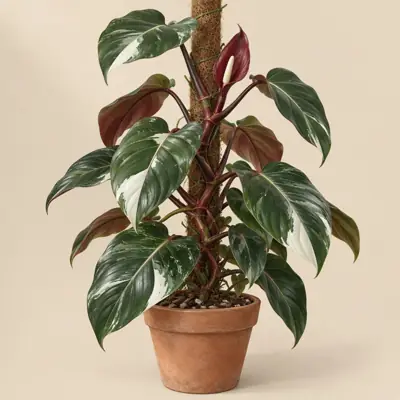
Sources differ on mature height, placing it at about 250–400 cm. A single source reports a mature spread of about 50–100 cm. Sources describe the glossy dark green leaves as ranging from ovate-triangular and somewhat arrow-shaped to heart-shaped, with undersides often red-purple, purple, or copper-red. It has a spadix surrounded by a red, red-purple, or burgundy spathe, and the spadix is also recorded as white; flowering is generally reported from summer into autumn.
Light
Philodendron erubescens does well in bright indirect light or bright filtered light and partial shade, can tolerate lower light, and should be kept out of strong direct sunlight.
Watering
Water moderately during the growing period, keeping the growing medium moist but well drained, and reduce watering at other times; avoid overwatering to reduce the risk of root rot.
Humidity and airflow
Philodendron erubescens prefers high humidity.
Temperature and dormancy
A single source reports a minimum temperature of about 15 °C. Its hardiness is generally reported as RHS H1A.
Growing medium and mounting
Use an organic-rich, moist but well-drained growing medium; RHS recommends a peat-free, loam-based potting medium, and the plant can adapt to acidic, neutral, or alkaline pH.
Feeding
A single source recommends applying a balanced liquid fertilizer monthly during the growing period.
Propagation
A single source reports propagation by surface-sowing seed in spring or by layering in spring.
Common problems
Potential pests include scale insects, greenhouse red spider mites or spider mites, mealybugs, aphids, and thrips. Sources differ in their descriptions of disease problems: root rot can result from overwatering and leaf spot can occur, while RHS generally describes the plant as having few diseases. A single source associates prolonged water on the leaves with the risk of leaf spot and reports that overwatering can lead to root rot. It does not tolerate low temperatures or cold drafts and requires greenhouse or indoor cultivation in temperate regions; strong direct sunlight should also be avoided.
Identification
Philodendron erubescens has a climbing habit, stems and petioles that may be red to reddish purple, glossy dark green leaves whose undersides are often red-purple or copper-colored, and spathes with red-purple tones.
Photos


Sources
- GBIF Backbone: Philodendron erubescens K.Koch & Augustin — CC BY 4.0 · link
- Wikipedia (en): Philodendron erubescens — CC BY-SA 4.0 · link
- Wikipedia (fr): Philodendron erubescens — CC BY-SA 4.0 · link
- GBIF descriptions: Catálogo de Plantas y Líquenes de Colombia; CATE Araceae — per dataset · link
- NC State Plant Toolbox: Philodendron erubescens — copyright (facts only) · link
- RHS Plants: Philodendron erubescens — © RHS, facts only · link