
Philodendron gloriosum (Philodendron gloriosum)
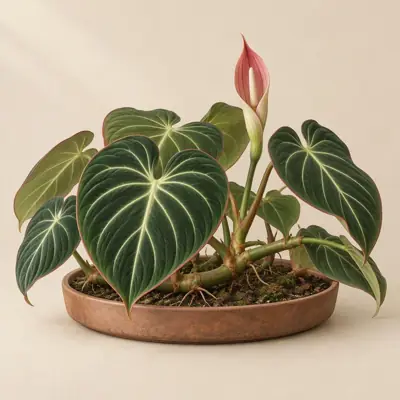
Philodendron gloriosum has a creeping habit, with stems extending horizontally over the ground, exposed tree roots, fallen logs, or rocks and able to attach at the nodes; it is not a typical climbing philodendron. It is reported to be a perennial herb.
Watch: Monstera vs Philodendron vs Alocasia vs Anthurium
Overview
Philodendron gloriosum has a creeping habit, with stems extending horizontally over the ground, exposed tree roots, fallen logs, or rocks and able to attach at the nodes; it is not a typical climbing philodendron. It is reported to be a perennial herb.
Origin and habitat
Sources differ on its native range, with Colombia recorded in the available accounts. Distribution records place it in Andean and Orinoquian biogeographic regions, where plants may creep horizontally over the forest floor, exposed tree roots, fallen logs, and rocks. Its climate is reported to be tropical.
Characteristics
With few sources, mature height is reported at about 60.96–152.4 cm. Sources differ in their descriptions of the leaves: they are deep green, heart-shaped to heart-ovate, may have a velvety texture, and have paler main and major lateral veins that may be pale green, white, or pinkish; the margins may be red to pink. The inflorescence is reported to consist of a spathe and spadix; the lower spathe is pale green, the upper portion is deep pink on both surfaces, the tube has white longitudinal stripes, and the spadix includes female- and male-flowered zones.
Light
It is generally grown in partial shade to shade; genus-level cultivation information also recommends bright, indirect light while avoiding strong direct sunlight.
Watering
It is generally watered regularly to keep the growing medium slightly moist without waterlogging, allowing the surface to dry somewhat before watering again.
Temperature and dormancy
A hardiness zone is reported for Philodendron gloriosum. It is generally frost tender; keep above freezing.
Growing medium and mounting
A loose, well-drained, organic-rich growing medium is generally recommended; a source for this species suggests potting soil combined with perlite, additional bark, and charcoal to make a loose mix. An airy mix is generally recommended.
Feeding
During the growing season, slow-release synthetic fertilizer or fast-acting liquid fertilizer may be applied on a regular schedule.
Propagation
It is generally propagated by stem cuttings or layering; genus-level cutting guidance describes taking cuttings with multiple nodes during a suitable part of the year and notes that they may root after a period of appropriate care.
Common problems
Genus-level information reports possible problems with slugs, spider mites, scale insects, mealybugs, aphids, and thrips. Genus-level information reports soft rot, leaf rot, leaf spot problems, and root rot associated with overwatering. Overwatering may cause root rot, while strong direct sunlight may scorch the leaves. It is frost sensitive and should be kept from freezing conditions; the genus as a whole is also described as sensitive to low temperatures.
Identification
Repeatedly cited identifying features are large, heart-shaped, velvety deep-green leaves with conspicuous pale veins and creeping stems that extend horizontally along the ground.
Photos


Sources
- GBIF Backbone: Philodendron gloriosum André — CC BY 4.0 · link
- Wikipedia (en): Philodendron gloriosum — CC BY-SA 4.0 · link
- GBIF descriptions: Catálogo de Plantas y Líquenes de Colombia; CATE Araceae — per dataset · link
- NHK みんなの趣味の園芸 植物図鑑: Philodendron (genus-level) — © NHK出版, facts only · link
- NC State Plant Toolbox: Philodendron (genus-level) — copyright (facts only) · link
- Top Tropicals catalog: Philodendron gloriosum — © Top Tropicals LLC (facts only) · link