
vilevine (Philodendron hederaceum)
Philodendron hederaceum is a perennial, evergreen, climbing or trailing hemiepiphytic vine that can climb tree trunks or supports or grow downward.
Watch: Monstera vs Philodendron vs Alocasia vs Anthurium
Overview
Philodendron hederaceum is a perennial, evergreen, climbing or trailing hemiepiphytic vine that can climb tree trunks or supports or grow downward.
Origin and habitat
Sources differ on its native range, describing it as extending through Mexico, Central America, the West Indies or Caribbean, and tropical South America, with South American records including Venezuela, the Guianas, Brazil, Ecuador, Peru, and Bolivia. Sources differ on habitat details; it grows in evergreen forests and cloud forests, often climbing trees as a hemiepiphytic vine, across a broad elevational range. It is a tropical plant and in temperate regions is mainly grown as a greenhouse or indoor foliage plant.
Characteristics
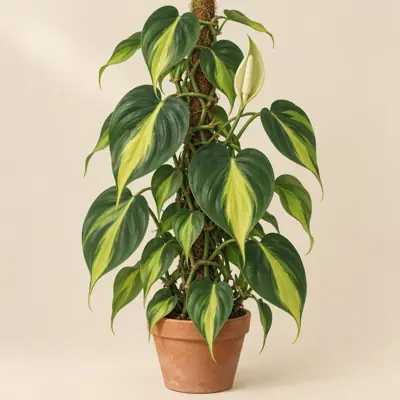
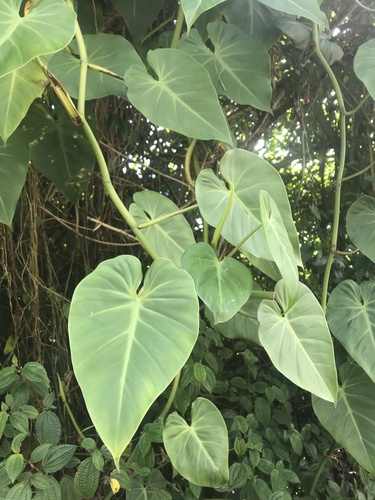
Sources differ, but the mature height is reported at about 61–122 cm; another source reports a mature spread of about 50–100 cm. Growth is fast, with alternate, simple leaves that are heart-shaped to broadly ovate with a tapering tip; mature leaves can become large, and the species may have glossy to nearly matte foliage, while 'Brasil' has yellow to light-green markings through the center with dark-green margins. Mature plants can form the typical aroid inflorescence, with a spathe surrounding a spadix; the spathe ranges from pale green or green to creamy white, the spadix is white, and flowering is uncommon indoors. It is reported to flower from spring through summer and to produce berries that may be greenish white.
Light
Bright indirect light is best for maintaining variegation; the plant tolerates lower light but should be kept away from strong direct sunlight.
Watering
Keep the growing medium slightly moist without waterlogging; during the growing season, water thoroughly after the surface has dried slightly, and reduce watering frequency when growth slows in winter.
Humidity and airflow
It is generally reported to prefer moderate humidity.
Temperature and dormancy
With few sources available, a minimum temperature of about 15 °C is reported. It is generally reported to be frost tender and should be kept above freezing. A hardiness range is also reported for the plant.
Growing medium and mounting
Use a loose, well-drained medium that retains moderate moisture; a loamy, slightly acidic medium can include bark or pumice to increase aeration and drainage. It has aerial and soil roots and does well with an airy mix.
Feeding
Feed regularly during the growing season; sources describe liquid indoor-plant fertilizer, slow-release fertilizer, or fast-acting liquid fertilizer on differing schedules, with one source advising that feeding stop in winter.
Propagation
Propagation can use shoot tips, stem sections with buds, cuttings, or layering, and spring, summer, or the main growing period is considered more suitable.
Common problems
Possible pests include aphids, spider mites, scale insects, mealybugs, thrips, and slugs. Leaf spot and root rot associated with excessive moisture can occur, while another Philodendron cultivation source also lists soft rot and leaf rot. Low light can weaken the variegation of 'Brasil' and cause elongated growth, strong direct light can fade or scorch variegated leaves, and waterlogging increases the risk of root rot. It does not tolerate low temperatures; in temperate regions it requires indoor or greenhouse cultivation and should be protected from cold conditions in winter.
Identification
The most distinctive feature is the broad yellow to light-green variegation through the center of the heart-shaped leaves, surrounded by dark green; the stems may climb or trail.
Photos


Sources
- GBIF Backbone: Philodendron hederaceum (Jacq.) Schott — CC BY 4.0 · link
- Wikipedia (en): Philodendron hederaceum — CC BY-SA 4.0 · link
- Wikipedia (es): Philodendron hederaceum — CC BY-SA 4.0 · link
- GBIF descriptions: Catálogo de Plantas y Líquenes de Colombia; Plantas vasculares que se han reportado en los bosques s — per dataset · link
- NC State Plant Toolbox: Philodendron hederaceum — copyright (facts only) · link
- TaiCOL 臺灣物種名錄: Philodendron hederaceum — CC BY 4.0 · link
- RHS Plants: Philodendron hederaceum — © RHS, facts only · link
- USDA PLANTS Database: Philodendron hederaceum — Public domain (US Government work) · link
- NHK みんなの趣味の園芸 植物図鑑: Philodendron hederaceum — © NHK出版, facts only · link
- How to Plant, Grow, and Care For Philodendron Brasil (www.epicgardening.com) — facts only (§12) · link
- Give Your Houseplant Collection Variety With The Philodendron Brasil (houseplantcentral.com) — facts only (§12) · link
- Philodendron Brasil Trailing Houseplant (highlandmoss.com) — facts only (§12) · link
- How to Plant, Grow, and Care For Philodendron Brasil — facts only (§12) · link
- Give Your Houseplant Collection Variety With The Philodendron Brasil — facts only (§12) · link