
Canary Island date palm (Phoenix canariensis)
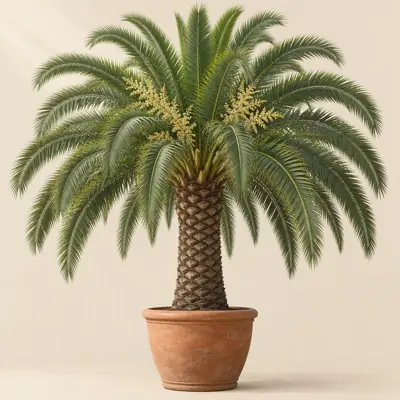
Phoenix canariensis is a large, evergreen palm with a single, upright, usually unbranched trunk, and male and female flowers occur on separate plants. It is a perennial evergreen.
Overview
Phoenix canariensis is a large, evergreen palm with a single, upright, usually unbranched trunk, and male and female flowers occur on separate plants. It is a perennial evergreen.
Origin and habitat
Phoenix canariensis is native to the Canary Islands. In its native range it occurs in warm forest zones, valleys, stream valleys and steep slopes, with large palm groves forming in some places; sources also describe its occurrence at different elevations on northern and southern slopes. Its native environment has a warm Mediterranean-type climate, while in cultivation it can adapt to Mediterranean, humid subtropical and some oceanic climates and is also widely grown in warm-temperate regions.
Characteristics
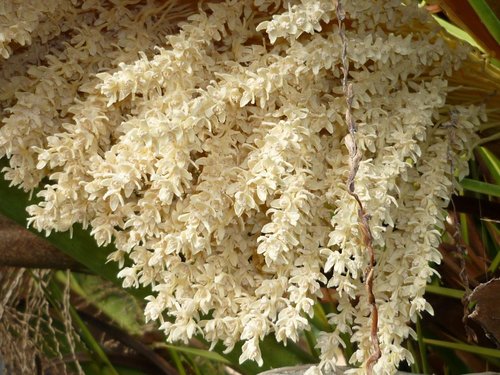
Sources differ on mature height, placing it at about 1000–2000 cm. Mature spread is 610–1220 cm. Growth is slow and is especially slow at the seedling stage. The large pinnate leaves are arching or drooping and form a dense crown on mature plants; basal leaflets can become sharp, spine-like structures. Sources describe leaf details differently. Male and female flowers occur on separate plants, with dense, branched or drooping inflorescences emerging between the leaves or from their axils; the flowers range from cream-yellow and yellow-white to yellow-orange. Sources differ on flowering time, which also varies by region. The fleshy fruits are generally ovoid to elliptical and become yellow, orange-yellow or reddish-yellow when mature, with thin flesh and a distinctly grooved seed; sources differ on fruit details.
Light
It prefers full sun to bright conditions but can also accept partial shade; when moved outdoors in summer, a sunny, relatively sheltered position with some midday shade is suitable.
Watering
Water moderately to regularly during active growth in a well-drained medium, allowing the surface to dry slightly before watering again; established plants are drought tolerant, and watering should be reduced in winter.
Temperature and dormancy
Sources differ on minimum temperature tolerance, with limited evidence indicating about -10 °C. It has a USDA hardiness classification. It is reported to tolerate brief light frost.
Growing medium and mounting
It prefers moist but well-drained, fertile loam or a loam-based potting medium with a slightly acidic to neutral pH.
Feeding
A balanced fertilizer is generally applied during the growing period.
Propagation
Propagation is by seed, with guidance recommending a warm sowing temperature.
Common problems
Potential pests include thrips, root mealybugs, scale insects, palm leaf-feeding insects and greenhouse red spider mites; other sources also identify weevil pests as affecting this species. It can be affected by Fusarium wilt, while other sources list Ganoderma rot, lethal yellowing and leaf spot as risks. Basal leaflets can form sharp, spine-like structures, and dried, aged leaves have been reported to trigger bronchial asthma in some individuals; in some regions the palm can escape cultivation, naturalize and even show invasive tendencies. Cold is a major weather risk, with leaves susceptible to cold injury and the plant facing greater risk under more severe or prolonged cold; young plants without a thick trunk are more vulnerable to freezing, while the species has some tolerance of salt spray from sea winds.
Identification
Phoenix canariensis is distinguished by a stout, single upright trunk with conspicuous diamond-shaped old leaf scars and a dense crown of large arching pinnate leaves; the basal leaflets can form very sharp spine-like structures.
Photos



Sources
- Wikipedia (en): Phoenix canariensis — CC BY-SA 4.0 · link
- 維基百科:加拿利海枣 — CC BY-SA 4.0 · link
- Wikipedia (ja): カナリーヤシ — CC BY-SA 4.0 · link
- Wikipedia (de): Kanarische Dattelpalme — CC BY-SA 4.0 · link
- Wikipedia (fr): Phoenix canariensis — CC BY-SA 4.0 · link
- Wikipedia (es): Phoenix canariensis — CC BY-SA 4.0 · link
- GBIF descriptions: Checklist of introduced taxa in Cyprus; Arbolado urbano de Bogotá D.C asociado a servicios ambiental — per dataset · link
- NC State Plant Toolbox: Phoenix canariensis — copyright (facts only) · link
- Useful Tropical/Temperate Plants: Phoenix canariensis — CC BY-NC-SA 3.0 (facts only) · link
- RHS Plants: Phoenix canariensis — © RHS, facts only · link
- USDA PLANTS Database: Phoenix canariensis — Public domain (US Government work) · link
- Top Tropicals catalog: Phoenix canariensis — © Top Tropicals LLC (facts only) · link