
date palm (Phoenix dactylifera)
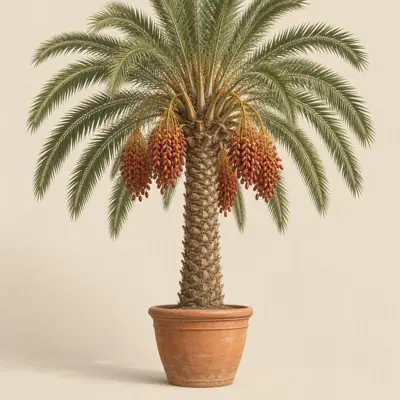
Phoenix dactylifera is a large evergreen, tree-like perennial palm with an upright, columnar form; it may grow as a single trunk or form a multi-trunked clump from the same root system.
Overview
Phoenix dactylifera is a large evergreen, tree-like perennial palm with an upright, columnar form; it may grow as a single trunk or form a multi-trunked clump from the same root system.
Origin and habitat
Sources differ on the exact native range because of its very long history of cultivation; accounts generally point to North or northeastern Africa and from western Asia into western South Asia, with some extending eastward into Central Asia, Pakistan, and India. It is closely associated with arid tropical and subtropical conditions and oasis agriculture, has long been cultivated, and in some areas occurs as an escape or naturalized plant as well as in gardens, parks, and other human-influenced settings. It prefers a hot, dry, sunny climate; hot, dry conditions favor fruiting, while normal fruiting is less likely in cooler or wetter climates.
Characteristics
Sources differ, placing mature height at about 1500–4000 cm and mature spread at about 600–1000 cm. It is reported to grow slowly. The evergreen, pinnate leaves are concentrated near the top of the stem to form a crown; the petiole or leaf base is spiny, and the leaflets are narrow and elongated. Male and female flowers occur on separate plants; the flowers are small, Phoenix inflorescences may form drooping panicles, and fruiting requires pollination, with artificial pollination commonly used in commercial cultivation.
Light
It prefers full sun; indoor cultivation requires bright, ample light.
Watering
The growing medium should drain well; water can be supplied generously during active growth after the medium dries, with less watering in winter, while dry production regions with insufficient rainfall require water from groundwater or irrigation.
Humidity and airflow
It is generally reported to need good airflow.
Temperature and dormancy
A single source reports a lower temperature of about -15 °C, so sources are few. Sources differ on an ideal temperature range of about 26–45 °C. A single source reports an upper temperature of about 52 °C, so sources are few. It is generally reported to be frost hardy, and hardiness classifications have also been given for it.
Growing medium and mounting
It adapts to various soils but requires good drainage; loamy or sandy soil can be used, it tolerates saline soil, and an alkaline, well-drained medium is also recommended.
Feeding
Slow-release fertilizer can be applied periodically, while greenhouse-grown plants may also receive balanced liquid fertilizer regularly during active growth.
Propagation
It can be propagated from seed, with sowing recommended in spring; commercial production also commonly uses vegetative material from high-yielding cultivars to preserve female plants and cultivated traits.
Common problems
It is reported to be susceptible to greenhouse red spider mites and scale insects. It is generally reported to have no notable disease problems. Cool or wet conditions can hinder fruiting, fruit production depends on effective pollination, and salinity, although tolerated, may reduce fruit quality. It favors hot, dry conditions; young leaves and new tissues can be seriously damaged by low temperatures, while other horticultural accounts describe it as frost-sensitive and recommend avoiding freezing conditions.
Identification
It is generally described as a tall, upright palm with a large crown of pinnate leaves, spiny petioles, and either a single trunk or multiple trunks arising from the base; male and female plants are separate, and pollinated female plants form clustered dates.
Photos


Sources
- GBIF Backbone: Phoenix dactylifera L. — CC BY 4.0 · link
- Wikipedia (en): Date palm — CC BY-SA 4.0 · link
- 維基百科:椰棗 — CC BY-SA 4.0 · link
- Wikipedia (ja): ナツメヤシ — CC BY-SA 4.0 · link
- Wikipedia (de): Echte Dattelpalme — CC BY-SA 4.0 · link
- Wikipedia (fr): Phoenix dactylifera — CC BY-SA 4.0 · link
- Wikipedia (es): Phoenix dactylifera — CC BY-SA 4.0 · link
- GBIF descriptions: Manual of the Alien Plants of Belgium; Checklist of introduced taxa in Cyprus; Arbolado urbano de Bo — per dataset · link
- Useful Tropical/Temperate Plants: Phoenix dactylifera — CC BY-NC-SA 3.0 (facts only) · link
- RHS Plants: Phoenix dactylifera — © RHS, facts only · link
- USDA PLANTS Database: Phoenix dactylifera — Public domain (US Government work) · link
- 臺北典藏植物園 植物資料庫: Phoenix dactylifera — © 臺北典藏植物園, facts only · link
- Top Tropicals catalog: Phoenix dactylifera — © Top Tropicals LLC (facts only) · link