
Senegal date palm (Phoenix reclinata)
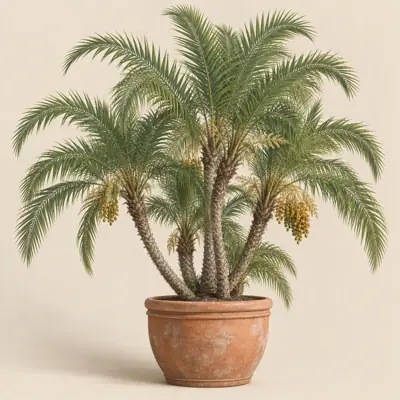
Phoenix reclinata is an evergreen, clustering, multi-stemmed tree-form palm whose usually unbranched stems are often curved and can form dense clumps. It is reported to be perennial.
Overview
Phoenix reclinata is an evergreen, clustering, multi-stemmed tree-form palm whose usually unbranched stems are often curved and can form dense clumps. It is reported to be perennial.
Origin and habitat
Its native range extends across broad parts of tropical Africa, the Arabian Peninsula, Madagascar, and the Comoros. It occurs in rainforest clearings, monsoon forest, open woodland, savanna, low scrub, rocky hillsides, riverbanks, and flood-prone lowlands, and is often found on alluvial soils where groundwater remains available. It is reported to inhabit humid tropical environments.
Characteristics
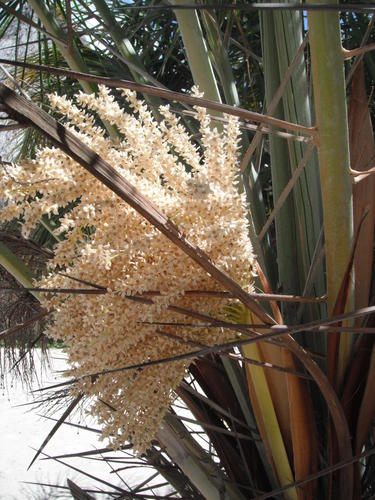
Sources differ on mature height, placing it at about 750–1500 cm. Growth is generally reported to be slow. The pinnate leaves curve backward and range from bright to dark green; the petiole has long, sharp spines at its base. The species is reported to be dioecious, with inflorescences near the stem apex; male flowers are pale yellow and fall after flowering, while female flowers are small, nearly spherical, and yellow-green.
Light
It is reported to grow well in full sun and tolerate light shade; it can survive deep shade, although shade may prevent fruiting.
Watering
It prefers moist but well-drained soil, while in the wild it tolerates seasonal waterlogging and can also grow in drier soils; with persistently high groundwater, it can tolerate moderate drought.
Temperature and dormancy
Few-source information places the lower temperature at about 15 °C, the preferred range at about 20–30 °C, and the upper temperature at about 35 °C.
Growing medium and mounting
It is generally reported to prefer light, moist but well-drained soil, while tolerating poor or dry soil and seasonal waterlogging; it also has a preferred soil pH and a broader reported tolerance range.
Common problems
Shade may prevent fruiting, and the long, sharp spines at the petiole bases can cause injury on contact. It tolerates heat, salt spray, and moderate drought where groundwater is sufficient, but sources differ on cold tolerance: some describe it as very sensitive to frost, while another reports tolerance of occasional frost.
Identification
Typical features include a clustering, multi-stemmed habit, often-curved stems, backward-curving pinnate leaves, and sharp spines at the petiole bases; it resembles the Canary Island date palm, but its multi-stemmed, curved form is conspicuous.
Photos


Sources
- Wikipedia (en): Phoenix reclinata — CC BY-SA 4.0 · link
- Wikipedia (de): Senegalesische Dattelpalme — CC BY-SA 4.0 · link
- Wikipedia (fr): Phoenix reclinata — CC BY-SA 4.0 · link
- Wikipedia (es): Phoenix reclinata — CC BY-SA 4.0 · link
- GBIF descriptions: Arbolado urbano de Bogotá D.C asociado a servicios ambientales y culturales valorados como base de l — per dataset · link
- Useful Tropical/Temperate Plants: Phoenix reclinata — CC BY-NC-SA 3.0 (facts only) · link
- USDA PLANTS Database: Phoenix reclinata — Public domain (US Government work) · link