
Dwarf Date Palm (Phoenix roebelenii)
Phoenix roebelenii is an evergreen perennial palm of small to medium stature; it can naturally form clumps with basal suckers, while cultivated plants are also often single-trunked.
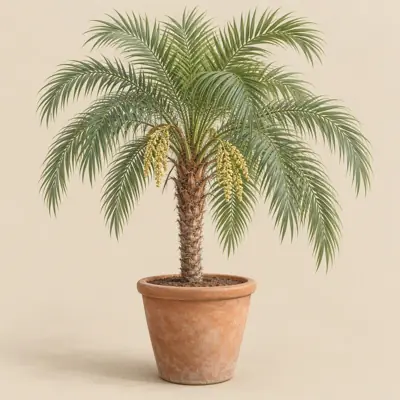
Overview
Phoenix roebelenii is an evergreen perennial palm of small to medium stature; it can naturally form clumps with basal suckers, while cultivated plants are also often single-trunked.
Origin and habitat
Sources differ on its native range, describing it from southwestern China to Indochina, with core records including Yunnan in China, northern Laos, and northern Vietnam. Its natural habitat is closely associated with rivers and riverbanks, where it can grow beside flowing water and tolerate seasonal flooding; a Chinese-language source also records riverbank habitat at elevated sites. It is native to warm regions of Southeast Asia and is widely used horticulturally in tropical and subtropical regions, while in colder regions it is generally grown in greenhouses or indoors.
Characteristics
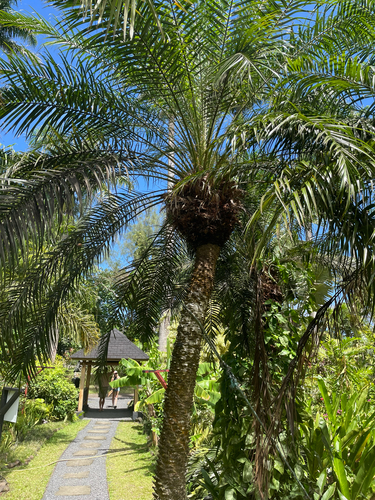
Sources differ on mature height, placing it at about 150–300 cm, while a single source reports a mature spread of about 150–250 cm. It is reported to grow slowly. Sources differ in describing the pinnate leaves, which are typically arching or soft in posture, with regularly arranged linear to narrow leaflets often held in one plane; descriptions include gray-green, dark green, or glossy foliage, and the basal leaflets can become sharp spines. The small yellow to yellowish-white flowers are borne among the leaves or on drooping, branched inflorescences, and male and female flowers occur on separate plants; flowering is reported in summer.
Light
It grows in full sun to partial sun; indoors or in a greenhouse, bright light is suitable while overly intense afternoon sun should be avoided.
Watering
During the growing period, keep the growing medium slightly moist to moist but well drained, avoiding overwatering that can cause root rot; reduce watering in winter, while sources also describe some tolerance of drought or fluctuations in watering.
Temperature and dormancy
Sources differ, with limited evidence placing the minimum temperature at about -3 °C.
Growing medium and mounting
The growing medium should be moist but well drained; horticultural sources support its adaptability to clay, loam, sand, and calcareous soils under acidic, neutral, or alkaline conditions.
Feeding
A single source recommends applying a balanced fertilizer during the growing period.
Propagation
A single source reports that Phoenix roebelenii can be propagated from seed and recommends sowing in spring.
Common problems
Potential pests include scale insects, greenhouse thrips, and greenhouse red spider mites. Disease problems are generally uncommon, but overwatering can cause root rot. Cold drafts should be avoided in winter, and scale insects and red spider mites can be concerns indoors or in greenhouses. It prefers warm conditions and should be protected from cold air currents; it can tolerate some low temperatures, but horticultural sources generally recommend greenhouse or indoor cultivation in colder regions.
Identification
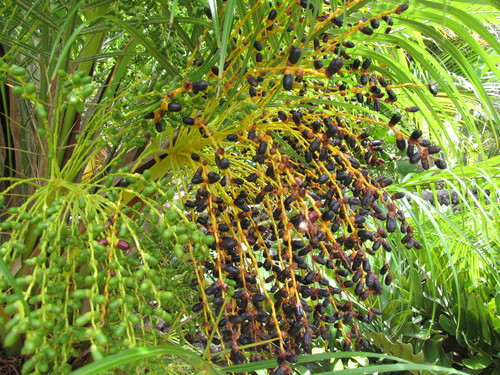
Phoenix roebelenii is distinguished by its small stature, relatively slender trunk, and soft, arching pinnate leaves with regularly arranged leaflets; the basal leaflets can form sharp spines, and mature plants bear small dark fruits.
Photos


Sources
- Wikipedia (en): Phoenix roebelenii — CC BY-SA 4.0 · link
- 維基百科:江边刺葵 — CC BY-SA 4.0 · link
- Wikipedia (ja): シンノウヤシ — CC BY-SA 4.0 · link
- Wikipedia (de): Zwerg-Dattelpalme — CC BY-SA 4.0 · link
- Wikipedia (fr): Phoenix roebelenii — CC BY-SA 4.0 · link
- Wikipedia (es): Phoenix roebelenii — CC BY-SA 4.0 · link
- GBIF descriptions: Arbolado urbano de Bogotá D.C asociado a servicios ambientales y culturales valorados como base de l — per dataset · link
- NC State Plant Toolbox: Phoenix roebelenii — copyright (facts only) · link
- RHS Plants: Phoenix roebelenii — © RHS, facts only · link