
Norway Spruce (Picea abies)
Picea abies is a large evergreen coniferous tree, typically with a conical form. It is a perennial evergreen.
Overview
Picea abies is a large evergreen coniferous tree, typically with a conical form. It is a perennial evergreen.
Origin and habitat
Sources differ on the details of its native European range, which is described as extending mainly through northern, central, and eastern Europe, south into the Alps, Carpathians, and Balkan mountains, north to Norway within the Arctic Circle, and generally east to around the Ural Mountains. In the northern part of its range it commonly occurs in boreal coniferous forest, while farther south it occurs mainly in moist montane to subalpine forest. It is adapted to cold to cool, relatively moist climates; in northern Europe it can occur in lowlands, while in central and southern Europe its natural distribution is more concentrated in mountainous areas.
Characteristics
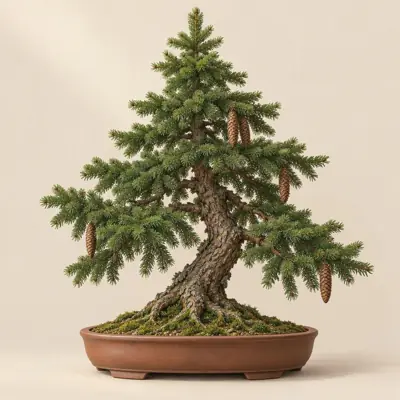
Sources differ, with the limited evidence placing mature height at about 3500–5500 cm. Sources differ on growth rate, but describe it as fast, especially for young trees under favorable conditions, with growth slowing as trees become taller. Sources differ in their descriptions of the foliage and cones: the stiff, densely borne needles are dark green to nearly black-green and roughly four-angled in cross-section, while the hanging cones are green or reddish when young, becoming brown at maturity, with scales ending in shapes ranging from blunt to sharply triangular. The flowers are reported to be yellow and inconspicuous, and flowering is reported to occur in spring to early summer.
Light
Picea abies grows in full sun.
Watering
It prefers ample moisture around the roots and moist, well-drained soil; it does not favor hot, dry conditions or prolonged waterlogging.
Growing medium and mounting
It is suited to moist, well-drained soil and can grow in clay, loam, or sandy soil. Horticultural sources favor acidic to neutral soil.
Propagation
It can be propagated from seed or by semi-ripe cuttings.
Common problems
Potential pests include adelgids, spider mites, and conifer aphids; other sources also list conifer pests and weevils. It is reported to be susceptible to disease caused by Armillaria. Hot, dry summers and prolonged waterlogging around the roots are reported to cause poor growth, and adaptation is reported to be poorer in the warmer southern United States. It prefers cool conditions and is sensitive to heat and drought; young shoots may be damaged by late frost, and wind resistance is poorer in shallow soil.
Identification
Picea abies is reported to be identifiable by its hanging mature cones, often drooping leafy twigs on older trees, and four-angled needles in cross-section; its cones are also reported to be among the particularly long cones in its genus.
Photos


Sources
- Wikipedia (en): Picea abies — CC BY-SA 4.0 · link
- 維基百科:歐洲雲杉 — CC BY-SA 4.0 · link
- Wikipedia (ja): オウシュウトウヒ — CC BY-SA 4.0 · link
- Wikipedia (de): Gemeine Fichte — CC BY-SA 4.0 · link
- Wikipedia (fr): Épicéa commun — CC BY-SA 4.0 · link
- Wikipedia (es): Picea abies — CC BY-SA 4.0 · link
- GBIF descriptions: Manual of the Alien Plants of Belgium; Database of Vascular Plants of Canada (VASCAN); Global Regist — per dataset · link
- NC State Plant Toolbox: Picea abies — copyright (facts only) · link
- Useful Tropical/Temperate Plants: Picea abies — CC BY-NC-SA 3.0 (facts only) · link
- RHS Plants: Picea abies — © RHS, facts only · link
- USDA PLANTS Database: Picea abies — Public domain (US Government work) · link