
Aluminium Plant (Pilea cadierei)
Pilea cadierei is an evergreen perennial herb with an upright to clumping habit; it can form underground rhizomes and spread as ground cover, with somewhat succulent stems whose bases may become woody with age.
Overview
Pilea cadierei is an evergreen perennial herb with an upright to clumping habit; it can form underground rhizomes and spread as ground cover, with somewhat succulent stems whose bases may become woody with age.
Origin and habitat
Sources differ on its native range, describing southern China and Vietnam, with Chinese records specifically including Guizhou and Yunnan. It is reported from moist, shaded forest sites in southern China. It prefers warm, humid, shaded conditions and is commonly grown as a houseplant in temperate regions.
Characteristics
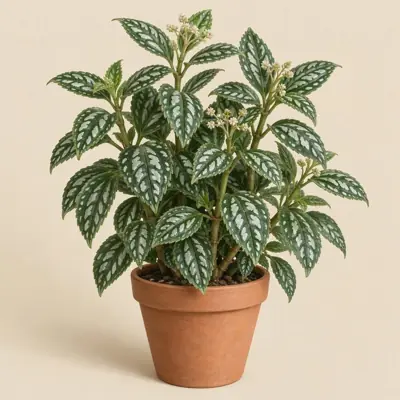
Sources differ on mature height, placing it at about 15–60 cm, while mature spread is 10–50 cm. The opposite, dark green leaves are elliptic to obovate, with conspicuous raised silvery-white patches or stripes and weakly serrated to serrated margins. Sources differ in their descriptions of the small, inconspicuous flowers; they are described as whitish-pink, with separate male and female flowers on the same plant, while male anthers can rapidly release pollen when disturbed, and flowering is uncommon indoors. It can spread through underground rhizomes to form dense ground cover under suitable conditions; Chinese records describe a flowering period and, from a single source, solitary, ovate, flattened nutlets with a recorded ripening period.
Light
Provide bright indirect light to partial or full shade, avoiding strong direct sunlight because it can damage or discolor the leaves.
Watering
Water moderately and regularly during the growing season, keeping the medium moist but well drained; the surface can dry slightly before watering again, and watering should be reduced from autumn through late winter. Overwatering or poor drainage can cause root rot.
Humidity and airflow
Pilea cadierei prefers high humidity.
Temperature and dormancy
Sources differ, with limited evidence suggesting a minimum temperature of about 15 °C. Sources also differ on its hardiness-zone classification. It is frost tender; keep above freezing.
Growing medium and mounting
Use a loose medium that retains moisture while draining well; a peat-based potting medium can be used. It can adapt to soils from acidic to slightly alkaline, and loam is also listed with acidic, neutral, or alkaline conditions.
Feeding
When grown as ground cover, it is reported to benefit from regular feeding to maintain dense, ornamental growth.
Propagation
It can be propagated from stem-tip cuttings, which root readily, and cuttings can be taken in early spring to renew plants.
Common problems
Sources differ on reported pests, which may include mealybugs, scale insects, aphids, and spider mites. Overwatering or poor drainage can lead to root rot, while high humidity combined with poor airflow may encourage powdery mildew. Strong direct sunlight can discolor the leaves; the plant prefers warm, frost-free conditions and is commonly grown indoors or in a greenhouse in temperate regions.
Identification
Its most conspicuous identifying feature is the dark green foliage with rows or irregular patches of raised metallic silvery-white markings; the leaves are opposite, and the plant can spread outward through underground rhizomes.
Photos


Sources
- Wikipedia (en): Pilea cadierei — CC BY-SA 4.0 · link
- 維基百科:花叶冷水花 — CC BY-SA 4.0 · link
- Wikipedia (de): Pilea cadierei — CC BY-SA 4.0 · link
- Wikipedia (fr): Pilea cadierei — CC BY-SA 4.0 · link
- Wikipedia (es): Pilea cadierei — CC BY-SA 4.0 · link
- NC State Plant Toolbox: Pilea cadierei — copyright (facts only) · link
- Useful Tropical/Temperate Plants: Pilea cadierei — CC BY-NC-SA 3.0 (facts only) · link
- RHS Plants: Pilea cadierei — © RHS, facts only · link
- Top Tropicals catalog: Pilea cadierei — © Top Tropicals LLC (facts only) · link