
Chinese money plant (Pilea peperomioides)
Pilea peperomioides is an evergreen perennial herb with an upright, compact to clumping habit; its stems are usually upright and may become slightly woody at the base when mature.
Overview
Pilea peperomioides is an evergreen perennial herb with an upright, compact to clumping habit; its stems are usually upright and may become slightly woody at the base when mature.
Origin and habitat
Sources differ on its native range, which is described as southwestern China, mainly western Yunnan and southwestern Sichuan. It inhabits moist, shaded rocks and rock faces in forests or cool, shaded mountain environments. Its native environment in southwestern China is generally cool, moist, and mountainous.
Characteristics
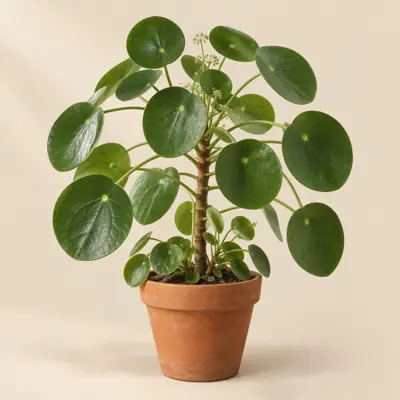
Sources differ on mature height, placing it at about 30–60 cm, while mature spread is 30–60 cm. It is reported to grow quickly and readily produce vigorous side shoots or underground shoots. The essentially hairless plant has glossy green to dark green leaves that are nearly round to elliptical, peltate, and borne on long petioles. Its flowers are small and inconspicuous, ranging from pale green or white to slightly pinkish, and flowering is uncommon indoors.
Light
Provide bright, indirect light to partial shade and avoid strong direct sunlight.
Watering
Use a well-drained growing medium and keep it moderately moist; the medium can be allowed to dry before watering, or the surface can be allowed to dry slightly before regular watering.
Humidity and airflow
Pilea peperomioides prefers high humidity.
Temperature and dormancy
With few sources and differing information, the reported minimum temperature is about 10–10 °C. It is generally reported for a USDA hardiness zone range, without a numerical range confirmed here. It is frost tender; keep above freezing.
Growing medium and mounting
Use a well-drained potting medium; a free-draining medium containing pine bark and perlite can be used. It can grow in acidic, neutral, or alkaline conditions, with sandy and chalky soils also listed.
Feeding
A general-purpose plant fertilizer is reported to be suitable in spring and summer.
Propagation
It can be propagated from side shoots or underground shoots produced by the parent plant, by division, or from stem cuttings. Seed propagation and separating rosette-like shoots in spring are also listed methods.
Common problems
Possible pests include spider mites, mealybugs, fungus gnats, and scale insects. Overwatering can lead to root rot, while wet leaves may develop leaf spots; powdery mildew may also occur. Insufficient light can cause leggy growth, poor growing conditions may leave the lower stem bare through leaf loss, and overwatering may cause root rot. Sources describe cold sensitivity differently: cultivated plants generally need protection from frost and cold drafts, while some accounts indicate that plants in their native habitat may briefly tolerate conditions near or below freezing and can regrow after frost kills the foliage.
Identification
The most conspicuous features are the nearly round, glossy, peltate leaves, whose long petioles attach near the center of the blade and give the leaves a coin- or disk-like appearance.
Photos


Sources
- Wikipedia (en): Pilea peperomioides — CC BY-SA 4.0 · link
- 維基百科:镜面草 — CC BY-SA 4.0 · link
- Wikipedia (de): Pilea peperomioides — CC BY-SA 4.0 · link
- Wikipedia (fr): Pilea peperomioides — CC BY-SA 4.0 · link
- Wikipedia (es): Pilea peperomioides — CC BY-SA 4.0 · link
- NC State Plant Toolbox: Pilea peperomioides — copyright (facts only) · link
- Wikipedia (nl): Pilea peperomioides — CC BY-SA 4.0 · link
- RHS Plants: Pilea peperomioides — © RHS, facts only · link
- Top Tropicals catalog: Pilea peperomioides — © Top Tropicals LLC (facts only) · link