
Pinguicula moranensis (Pinguicula moranensis)
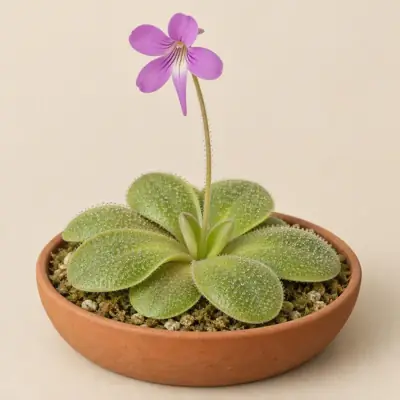
Pinguicula moranensis is a perennial carnivorous herb forming rosettes, with pronounced seasonal dimorphism: it forms ground-hugging carnivorous rosettes during the growing season and small, succulent, non-carnivorous rosettes during the dry season or winter.
Overview
Pinguicula moranensis is a perennial carnivorous herb forming rosettes, with pronounced seasonal dimorphism: it forms ground-hugging carnivorous rosettes during the growing season and small, succulent, non-carnivorous rosettes during the dry season or winter.
Origin and habitat
Sources differ on its native range, describing it as occurring in Mexico, Guatemala, El Salvador, and Honduras. It can occur in relatively open or bright mountain environments, including wetter habitats, alkaline gypsum-bearing sites, open pine and oak woodland, and temperate montane forest. It is reported to follow a wet- and dry-season rhythm, producing carnivorous summer-type leaves when conditions are wetter and prey is abundant, then forming small non-carnivorous winter-type leaves and entering dormant growth during the dry season.
Characteristics
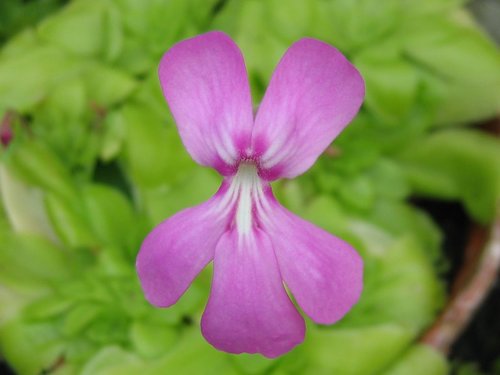
Sources differ and are few, placing mature spread at about 0.5–20 cm, while a limited source reports mature height at about 10–25 cm. Sources differ in their descriptions of the foliage: summer-type leaves are flat, fleshy, carnivorous, and usually obovate to nearly round, with stalked mucilage glands and sessile digestive glands that trap and digest arthropods, whereas dry-season winter-type leaves are smaller, fleshy, glandless, and spatulate to oblong-spatulate. Flowers are reported to be solitary on upright stalks, with bilaterally symmetrical, long-spurred corollas commonly ranging in color from pink and reddish purple to violet; rare white-flowered forms are also reported, and pollination is reported to produce capsules containing many seeds. Sources differ on flowering, reporting flowering from both summer- and winter-type rosettes and flowering more than once within the annual cycle; growth rate has not been quantified, although the cultivar 'Superba' is reported to be vigorous.
Light
Pinguicula moranensis is generally reported to need bright light, with genus-level horticultural information recommending full sun to partial sun.
Watering
It is reported to need moist conditions during the growing season, while reduced water during the dry season or winter is associated with formation of the non-carnivorous winter-type rosette; genus-level cultivation information recommends keeping the growing medium continuously moist. A limited source suggests a watering interval of about 3–5 days. Tray (bottom) watering is reported to be compatible, with conditions kept slightly drier during rest.
Humidity and airflow
A limited source gives a preferred humidity of about 60–100 % and reports that the plant prefers high humidity. It is also reported to need good airflow.
Temperature and dormancy
A limited source gives an ideal temperature range of about 20–30 °C, with a reported minimum of about 10 °C and maximum of about 30 °C. It is generally reported to have cold winter dormancy.
Growing medium and mounting
Sources differ in describing its substrate conditions: it can grow in nutrient-poor substrate, while another account reports a preference for alkaline, gypsum-bearing habitat. Sand with peat is reported as a substrate type.
Feeding
The plant is reported to capture and digest arthropods, using nutrients obtained from prey to supplement those available in nutrient-poor substrate.
Common problems
Poor airflow is reported to increase the risk of rot, and cultivation information recommends maintaining good airflow throughout the year to reduce this risk. Because the leaves have structures that pass through the cuticle for digestion, they are reported to face increased water-loss risk, so excessively dry conditions may make it harder for carnivorous leaves to retain water. Growth and water needs are reported to be strongly seasonal, with moist conditions during summer cultivation and substantially reduced watering in winter. Genus-level horticultural information is reported not to identify significant pest problems.
Identification
The most distinctive feature is the seasonally dimorphic rosette: large, sticky carnivorous leaves occur during the wet growing season, while the plant shifts to a small, fleshy, non-carnivorous rosette during the dry season or winter; mucilage glands trap arthropods and digestive glands break down the prey.
Photos


Sources
- GBIF Backbone: Pinguicula moranensis Kunth — CC BY 4.0 · link
- Wikipedia (en): Pinguicula moranensis — CC BY-SA 4.0 · link
- 維基百科:墨蘭捕蟲堇 — CC BY-SA 4.0 · link
- Wikipedia (de): Geschwänztes Fettkraut — CC BY-SA 4.0 · link
- Wikipedia (fr): Pinguicula moranensis — CC BY-SA 4.0 · link
- Wikipedia (es): Pinguicula moranensis — CC BY-SA 4.0 · link
- NC State Plant Toolbox: Pinguicula (genus-level) — copyright (facts only) · link
- Pinguicula moranensis 'Superba' Butterwort – Carnivero (www.carnivero.com) — facts only (§12) · link
- Oliver Gluch's World of Carnivorous Plants - Cultivation (www.gluch.info) — facts only (§12) · link
- 捕蟲堇抓小黑蚊嗎? 5 種捕蟲堇抓蚊子效果超好!(含照顧指南) - 微體溫室 Micro Oasis (micro-oasis.com) — facts only (§12) · link