
southern butterwort (Pinguicula primuliflora)
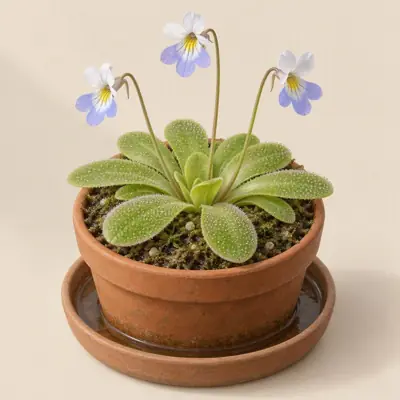
Pinguicula primuliflora is a perennial carnivorous herb whose leaves form a basal rosette; genus-level information describes the plant as having a somewhat creeping habit.
Overview
Pinguicula primuliflora is a perennial carnivorous herb whose leaves form a basal rosette; genus-level information describes the plant as having a somewhat creeping habit.
Origin and habitat
Pinguicula primuliflora is native to the southeastern United States, and the USDA lists it as native within the contiguous United States. It occurs on the coastal plain of the southeastern United States in poor, acidic, moist soils. It prefers warm, moist conditions with abundant sunlight, and sources also characterize its distribution environment by a USDA hardiness zone.
Characteristics
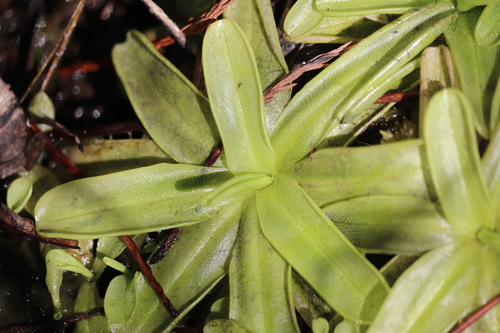
Sources describe the green leaves as bearing fine glandular hairs that secrete mucilage to trap arthropods; genus-level information also describes the leaves as simple, entire, and arranged in a basal rosette, though sources differ in their descriptions. The typical form has white, bilaterally symmetrical flowers with petals and is generally single-flowered in form; the flower shape is described as resembling a primrose, and flowering occurs in spring. With few sources, mature height is reported to be about 5.08–30.48 cm and mature spread about 2.54–15.24 cm; growth is generally reported to be slow. The fruit is reported to be a capsule that becomes brown to copper-colored when mature; genus-level information describes the fruit as small.
Light
Pinguicula primuliflora grows from partial sun to full sun and can accept direct sunlight; it does not require extremely intense light to flower and form sticky insect-trapping leaves.
Watering
Keep the medium moist; it can be watered thoroughly from above, while another source notes that a water tray can maintain soil moisture and increase surrounding humidity. Top watering is generally reported as suitable, with the target being to keep evenly moist. With few sources, watering is reported at about 3–5 days in summer and about 5–7 days in winter.
Humidity and airflow
Pinguicula primuliflora prefers moderate humidity.
Temperature and dormancy
With few sources, a minimum of about -9 °C is reported. Sources differ in their hardiness descriptions: species-level and genus-level sources give different USDA zone information. It is reported to tolerate brief light frost and to have cold winter dormancy.
Growing medium and mounting
Use a poor, acidic medium; described options include peat with perlite or horticultural sand, pure sphagnum peat, or a granular medium incorporating materials such as akadama, orchid stone, and perlite with peat and a sphagnum surface layer to retain moisture. Peat with perlite is also reported as a substrate type.
Feeding
The growing medium is reported to be left unfertilized; the plant obtains nutrients, including nitrogen, by trapping and digesting arthropods. Its leaves trap and digest small insects, providing nutrients needed in nutrient-poor environments.
Propagation
Pinguicula primuliflora can be propagated from seed produced through self-pollination or by cross-pollinating with another plant, with cross-pollination described as more effective; genus-level information also recommends seed propagation.
Common problems
Cultivated plants are reported to produce many new shoots that can gradually fill the container, requiring some management. It is reported to tolerate brief cold conditions, but the source does not support prolonged exposure to such low temperatures; extremely high humidity is not required. The sources are reported not to list any known major pest or disease problems.
Identification
Pinguicula primuliflora has sticky insect-trapping leaves that capture and digest arthropods; the typical form has white flowers with petals and a shape resembling a primrose.
Photos


Sources
- Wikipedia (en): Pinguicula primuliflora — CC BY-SA 4.0 · link
- USDA PLANTS Database: Pinguicula primuliflora — Public domain (US Government work) · link
- NC State Plant Toolbox: Pinguicula (genus-level) — copyright (facts only) · link
- 捕蟲堇抓小黑蚊嗎? 5 種捕蟲堇抓蚊子效果超好!(含照顧指南) - 微體溫室 Micro Oasis (micro-oasis.com) — facts only (§12) · link