
Japanese Black Pine (Pinus thunbergii)
Pinus thunbergii is a perennial evergreen coniferous tree whose natural crown may be broadly conical, umbrella-shaped, or irregular and spreading with age.
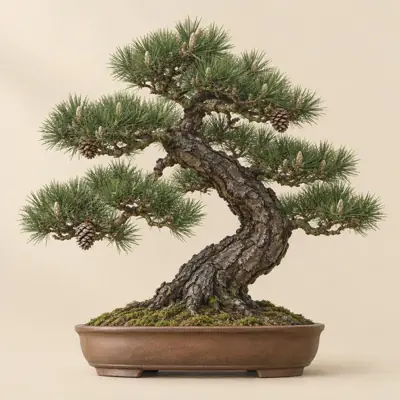
Overview
Pinus thunbergii is a perennial evergreen coniferous tree whose natural crown may be broadly conical, umbrella-shaped, or irregular and spreading with age.
Origin and habitat
Sources differ on its native range, describing it as native to Japan and South Korea, with its Japanese range mainly along coastal areas of Honshu, Shikoku, and Kyushu. It commonly occurs on coasts, coastal dunes, coastal hills and mountains, and may also grow on rocky cliffs, dry slopes, or ridges. It occurs in warm-temperate environments and shows pronounced adaptation to coastal conditions in its native habitat; mature dormant plants have some cold tolerance.
Characteristics
Sources differ, with the limited evidence placing mature height at about 2000–4000 cm and mature spread at about 400–800 cm; growth is moderate. Sources differ in their descriptions of needle size, while describing the needles as dark green, coarse, stiff, pointed, grouped in bundles, and sheathed at the base. It is reported to bear male and female reproductive structures on the same tree, with clustered male pollen cones at the base of new spring shoots and female cones at branch tips that may be reddish purple when young; reproductive activity is reported from spring into late spring. Seed cones are reported to become pale brown to gray-brown when mature, with numerous scales; they take an extended period to mature, and the seeds are winged.
Light
Pinus thunbergii prefers full sun.
Watering
It prefers moist but well-drained soil; established plants have some drought tolerance and can also adapt to sandy and coastal environments.
Temperature and dormancy
Limited single-source evidence reports a minimum temperature of about -20 °C, and the available source also reports a hardiness rating of RHS H7.
Growing medium and mounting
It prefers well-drained conditions and can grow in loamy, sandy, or chalky soils across acidic, neutral, and alkaline conditions, while also adapting to coarser-textured soils.
Propagation
Propagation is mainly by seed, while horticultural plants may also be grafted; cuttings are considered more difficult, and RHS recommends grafting in late winter.
Common problems
Potential pests include adelgids, conifer aphids, sawfly larvae, and pine shoot moths; mortality associated with the pinewood nematode Bursaphelenchus xylophilus has also been recorded in North America. Potential diseases include Armillaria-associated root disease and needle-cast disease, while pinewood nematode infestation may also be accompanied by invasion by blue-stain fungi and rapid decline. In commercial circulation it may be mistaken for Pinus nigra, and pinewood nematode together with various conifer pests and diseases are concerns. It tolerates coastal conditions, salt, heat, and some drought, while strong exposure may bend the trunk and flatten the crown.
Identification
Older trees have thick, dark gray to dark brown bark that becomes deeply fissured or plate-like; the needles are dark green, stiff, and grouped in bundles, while the conspicuous winter buds are white to silvery white. Compared with red pine, it generally has darker bark and stiffer needles.
Photos


Sources
- Wikipedia (en): Pinus thunbergii — CC BY-SA 4.0 · link
- Wikipedia (ja): クロマツ — CC BY-SA 4.0 · link
- Wikipedia (de): Japanische Schwarzkiefer — CC BY-SA 4.0 · link
- Wikipedia (fr): Pin noir du Japon — CC BY-SA 4.0 · link
- Wikipedia (es): Pinus thunbergii — CC BY-SA 4.0 · link
- NC State Plant Toolbox: Pinus thunbergii — copyright (facts only) · link
- Useful Tropical/Temperate Plants: Pinus thunbergii — CC BY-NC-SA 3.0 (facts only) · link
- RHS Plants: Pinus thunbergii — © RHS, facts only · link
- USDA PLANTS Database: Pinus thunbergii — Public domain (US Government work) · link