
Platycerium alcicorne (Platycerium alcicorne)
Platycerium alcicorne is a wild species (not a hybrid or cultivar) and a perennial fern. It is reported to be an epiphytic fern that can grow on trees and can also be mounted on a board, grown in a basket, or cultivated in a well-drained medium.
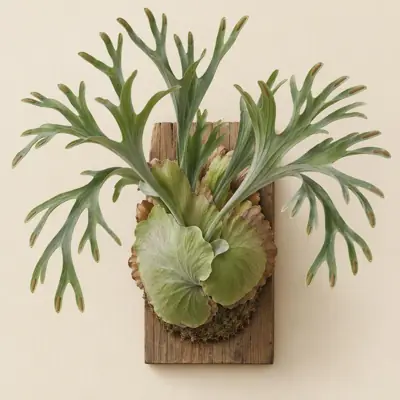
Overview
Platycerium alcicorne is a wild species (not a hybrid or cultivar) and a perennial fern. It is reported to be an epiphytic fern that can grow on trees and can also be mounted on a board, grown in a basket, or cultivated in a well-drained medium.
Origin and habitat
Its native range includes Madagascar, Seychelles, the Comoros, Mozambique, and Zimbabwe; other sources describe the range more broadly as continental Africa and Madagascar. It occupies epiphytic habitats; descriptions of Platycerium alcicorne characterize its natural environment as relatively shaded and humid, while Platycerium species are typically found on tree trunks or branches. It is reported to occur in tropical to subtropical environments that are warm and humid.
Characteristics
Few sources report a mature spread of about 45–60 cm and a mature height of about 10–150 cm. It has shield fronds close to the base and fertile fronds that grow outward or obliquely upward, fork at the tips, and can develop spore-bearing areas; the shield fronds of Platycerium alcicorne have little apical division, while the Madagascar form is usually darker green with more highly forked fertile fronds. The shield fronds are reported to be small and flat, covering the roots and collecting water and fallen plant debris to form a nest-like structure. Fertile fronds grow obliquely upward and fork at the tips, but may also hang downward under weaker light.
Light
Sources describe this differently: bright indirect light is the main growing condition, with young plants avoiding strong direct light, while established plants may be gradually exposed to higher light and some may acclimate to stronger sun. Platycerium alcicorne does not tolerate direct sun.
Watering
It is reported to do best when the medium is allowed to dry slightly after watering before more water is given, avoiding prolonged wetness; water demand is higher in warm seasons and watering is reduced in winter or during cool, cloudy conditions. Few sources report summer watering intervals of about 2–7 and winter intervals of about 4–7. The root zone is generally kept slightly dry.
Humidity and airflow
Platycerium alcicorne prefers high humidity and is reported to need good airflow. A limited source base reports humidity of about 70–80 %.
Temperature and dormancy
Few sources report a minimum of about 15 °C, while sources differ on an ideal range of about 15–25 °C. It is reported to be frost tender and should be kept above freezing; it is also reported to be sensitive to cold and not very sensitive to heat.
Growing medium and mounting
A moisture-retentive but well-drained and well-aerated medium is suitable; sphagnum moss can be used for mounting, while mature plants can use sphagnum mixed with bark or coconut fiber. It is reported to grow on trees as an epiphyte and can be mounted, grown in a basket or potted.
Feeding
Sources differ on feeding intervals, but describe using a balanced fertilizer during active growth and reducing feeding in winter or when growth slows.
Propagation
It can be propagated by dividing offsets or young plants, and Platycerium can also be propagated by spores, although this process is described as slow and difficult. Spores are reported to form in brown patches or sporangia on the underside of fertile fronds, and propagation from spores is slow and difficult.
Common problems
Scale insects may occur; genus-level information also lists mealybugs and aphids. Overwatering or waterlogged medium can cause root rot and blackening of shield fronds, while insufficient water can cause browning or curling at the frond tips. It is reported to be sensitive to frost and low temperatures, with protection or indoor shelter advised during cold conditions.
Identification
Its most conspicuous identifying feature is the combination of basal shield fronds and antler-like fertile fronds; brown spore-bearing areas can form on the underside of the fertile fronds.
Photos


Sources
- Wikipedia (en): Platycerium alcicorne — CC BY-SA 4.0 · link
- UF/IFAS Gardening Solutions — Staghorn Ferns: Platycerium (genus-level) — © University of Florida IFAS Extension, facts only · link
- Rainforest Flora care guide: Platycerium (genus-level) — © Rainforest Flora, facts only · link
- NHK みんなの趣味の園芸 植物図鑑: Platycerium (genus-level) — © NHK出版, facts only · link
- NC State Plant Toolbox: Platycerium (genus-level) — copyright (facts only) · link
- 圓盾鹿角蕨 - PlatyWiki 鹿角蕨百科 (platywiki.org) — facts only (§12) · link
- 圓盾鹿角蕨只有非圓與馬圓?非洲圓盾&馬島圓盾10大品種圖鑑 - 微體溫室 Micro Oasis (micro-oasis.com) — facts only (§12) · link